-
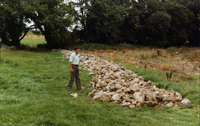 Bernard Finan checking materials for the playing fields, 1984-1986
This photograph was taken, c. 1984-1986, during work on the foundations of playing-fields on the north campus, across from Menlo Castle .
-
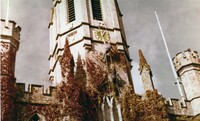 Cleaning the Clock Tower, mid 1970s to mid 1980s
This picture, taken from outside the Quadrangle, looking north-west, shows the iconic Clock Tower undergoing maintenance. Taken In the days before stringent health and safety rules were introduced, it shows the agility and bravery needed by Buildings & Grounds staff in order to keep the Virginia creeper from obscuring the College clock. The height of the Tower is 108 feet.
-
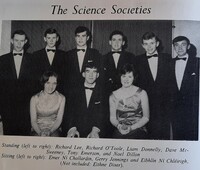 The Science Society
The Scientific Society, later renamed the Science Society, was founded by Seán Óg (J.J.) McHenry, in 1928 (UCG College Annual, 1927-28). McHenry was appointed as Assistant Examiner in the Dept. of Experimental Physics & Mathematical Physics in 1922 (O’Connor, 1999) and became a Lecturer in 1929. He was awarded a D.Sc. degree in 1931. He went to University College Cork in 1933, becoming Prof. in Experimental Physics and later becoming President.
The Science Society later became known as ‘an Cumann Éargna Aicionta’. According to the UCG College Annual of 1957-58), ‘membership of the Science Society is confined to members of the Science Faculty proceeding to a purely scientific degree who pay one shilling subscription before the 1st of December’.
The ‘sister’ Cumann Ceimice na Gaillimhe was founded in 1949. The Cumann Ceimice was first to organise educational trips / tours abroad, with the first one taking place to Belgium in 1959. A tour to France in 1960 included members from the Science Society. The Science Society organised their first tour to the Continent (to Vienna) in 1965. This was followed by trips to Germany in 1966 and in 1968.
The inaugural Science Dress Dance took place in the Warwick Hotel in 1966. A picture of the Dress Dance Committee is shown with names given below the picture. The Science Dress Dance Committee in 1967 is also shown with names given below the picture.
Unfortunately, the Science Society became ‘extinct’ in the late 1980’s with the advent of new Societies which were more discipline oriented, such as the Physics Society formed in 1988.
-
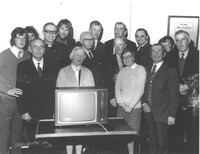 Fr Tom Kyne Retirement Presentation
This was a Retirement Presentation function for Fr Tom Kyne, (Catholic) Dean of Residence, in about 1974 in the Men's Club (as shown by the notice on the wall regarding the rules of Billiards).
He was presented with a television set at the function attended by a wide variety of his colleagues.
Fr Kyne's title was not 'Chaplain', but 'Dean of Residence', which was a statutory office from the outset as one of the 'Officers of Residence' (Statute I (1911), later retitled 'Deans of Residence'. Each religious denomination was entitled to nominate a clergyman for appointment as Dean of Residence in respect of students of that denomination. The Deans' duties involved supervision of the general conduct of students outside the precincts of the College, whereas the prime focus of the duties of the Lady Superintendent (also a statutory office) was the supervision of the conduct of women students within the precincts of the College. The establishment of 'Deans of Residences' from the early days of QCG (1857 onwards) in respect of each of the main religious denominations (although not taken up by the Catholic Hierarchy) was largely a means of enabling spiritual care for students of each denomination, linked to an inspection of the licensed boarding-houses where they stayed, all within the fraught environment of the establishment of the Queen's Colleges on a non-denominational basis.
-
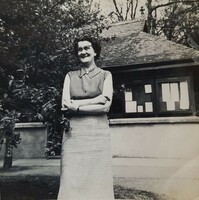 Mrs. Creaven 'Ma Creaven' and the college coffee shop
Mrs. Anne Creaven, known to all as 'Ma Creaven', ran the college coffee shop from the early 1950s until her retirement in 1982. The coffee shop was the only place on campus where tea, coffee and food could be purchased, and it became the social hub of the college. The title 'Ma' was conferred on a few distinguished ladies in the college 'who had by their qualities of fairness, or learning, or strength of character or sheer personality, earned the respect of even the irreverent. One graduate described Mrs. Creaven as she 'stood at the cash register at the end of the counter, tweed suited in winter time, twinsetted by summer. She presided over her domain like a Sergeant Major over his barracks, and even the highest ranks acknowledged her dominion. Her eagle eye missed nothing, and her memory was elephantine.' Students were not permitted to linger too long in the coffee shop, and were encouraged by Mrs. Creaven to 'get up out of that and go to your lectures!' Nonetheless, her numerous acts of kindness to those in distress were fondly remembered by a great many students. Mrs. Creaven retired in October 1975. She died in June 1982.
-
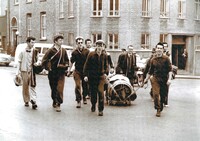 Student Barrel Roll for Charity
In response to a famine in the Congo, in 1961 a group of UCG students decided to roll a Guinness barrel from Galway to Dublin for charity. The bands fell off the barrel by the time they got to St. Patrick's Church, so they borrowed a pram and continued on their journey to Ballinasaloe, pushing the barrel in the pram. By then the pram had 'given up the ghost' and a local auctioneer replaced it. Along the route they collected money and were provided with free hotel accommodation and meals. At Kinnegad a local blacksmith had to do emergency repairs to the pram, but the group eventually arrived at St. James' Gate in Dublin and presented Major General J. Sweeney, general secretary of the Red Cross, with the proceeds of their charity walk, £135 - a considerable sum. Messrs. Guinness presented them with the barrel as a souvenir, and it was later displayed in a glass case at UCG.
-
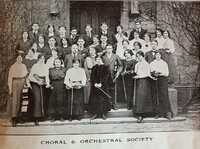 University Choral & Orchestral Society, 1915
The first picture shows a combined group of orchestral people along with a choral group. The second picture shows the choral group on their own. Music notes describing some of their activities and renditions is given in an article ‘Music Notes’ (UCG Annal, 1915-16). Miss Fogarty was appointed Conductor of the University Choral & Orchestral Society in the first term of academic year 1915-16. The article described preparations for the upcoming Concert in the Town Hall. Rehearsals took place in the Greek Hall. A tour de force of the Choir was the Miserere scene from ‘Il Trovatore’. A minor hiccup occurred with the news that three or four prominent Society members were going to Cork to play in the Camogie Ashbourne Cup competition.
Carriages conveyed the artistes to the Town Hall on the night and ‘an excellent attendance was visible when the curtains rose’. Performances included a violincello solo of Mackenzie’s ‘Larghetto’ and ‘Allegretto’. A popular success of the evening was the rendering of ‘Teddy O’Neale’.
Dr. and Mrs Pye were thanked for their keen interest they took in the work of the Society – Professor Joseph Pye was then Registrar. Dr. Senier (Professor of Chemistry) and Prof. Rishworth (Professor of Civil Engineering) were also thanked in their respective capacities as President and Treasurer of the Society.
-
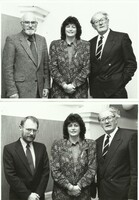 Léacht Bhord na Gaeilge, 1988 - Máire Geoghegan-Quinn
Seo Máire Geoghegan-Quinn sa Choláiste le Léacht bhliantúil Bhord na Gaeilge a thabhairt i 1988. Ba Aire Stáit í i Roinn an Taoisigh ag an am. Léi sa ghrianghraf ar barr tá Uachtarán an Choláiste agus an tOllamh le Nua-Ghaeilge. Léi sa ghrianghraf ag bun tá Uachtarán an Choláiste agus an tOllamh le Geilleagar.
Máire Geoghegan-Quinn in the College to deliver the annual Bord na Gaeilge lecture in 1988. She was Minister of State in the Department of the Taoiseach at the time. With her in the upper photograph are the President of the College and the Professor of Modern Irish. With her in the lower photograph are the President of the College and the Professor of Economics.
-
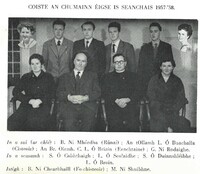 Coiste an Chumainn Éigse agus Seanchais 1957 – 58
The picture is that of Coiste an Chumann Éigse is Seanchais 1957-58, with names given in the picture caption. It includes an tOllamh Liam Ó Buachalla, Lecturer in Economics, Commerce and Accountancy (1928-1952), Prof. of Economics, Commerce and Accountancy (1952-1969). Cumann Éigse is Seanchais produced the irisleabhar FÍR, whose holdings are in Archives & Special Collections of the University of Galway Library. It contains holdings from 1941, Imleabhar (Volume) III, Uimhir (Issue) I to 1958, Imleabhar IV, Uimhir 12 (Geraldine Curtin, 2024). Interestingly, the Eagarthóir (Editor) and Fo-Eagarthóir (Sub-Editor) of the 1941 – 42 Uimhir III, Irisleabhar FÍR was Seán Mac Réamoinn and Siobhán Nic Cionnaith.
-
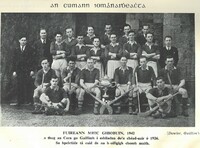 Fitzgibbon Hurling Team of 1942
The picture shows eighteen men dressed in sports gear, with the front eight men holding hurling sticks or 'camáns'. Four of the men were Oifigí or Officers of the UCG Hurling Club, who were more formally dressed with ties. It was the occasion of the UCG Hurling Club winning the Fitzgibbon Cup (Wikipedia, Fitzgibbon, Apr. 2024) for the first time since 1926. The picture was taken by William Dowler, professional photographer, Presentation Road, Galway.
The picture appeared in Imleabhar (Volume) 3, Uimhir (Number) 1 of an Cumann Éigse is Seanchais's periodal FÍR, 1941-42.
-
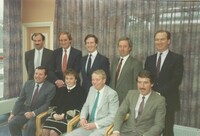 Galway-Derry-Boston Ventures
This group from Galway participated with a group from Derry in a promotional visit to Boston in the mid-1980s, with a view to developing and promoting investment and economic development, tourism and other linkages. The initiative, with which John Hume was deeply involved from the outset, began with the Derry-Boston connection - which led to major economic developments in Derry - before becoming the Galway-Derry-Boston Ventures. The Galway group included representatives of the Chamber of Commerce, Údarás na Gaeltachta, the IDA and the University. On this occasion, the group joined up with the Derry delegation in Boston, whereas in 1990 (see RTÉ News report cited below) the special charter flight from Derry picked up the Galway group in Shannon.
-
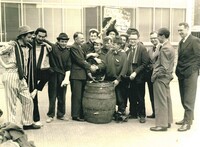 Students Barrel Roll from Galway to Dublin for charity.
In response to a famine in the Congo, in 1961 a group of UCG students decided to roll a Guinness barrel from Galway to Dublin for charity. The bands fell off the barrel by the time they got to St. Patrick's Church, so they borrowed a pram and continued on their journey to Ballinasaloe, pushing the barrel in the pram. By then the pram had 'given up the ghost' and a local auctioneer replaced it. Along the route they collected money and were provided with free hotel accommodation and meals. At Kinnegad a local blacksmith had to do emergency repairs to the pram, but the group eventually arrived at St. James' Gate in Dublin (where the photo was taken) and presented Major General J. Sweeney, general secretary of the Red Cross, with the proceeds of their charity walk, £135 - a considerable sum. Messrs. Guinness presented them with the barrel as a souvenir, and it was later displayed in a glass case at UCG.
Students (l-r) Ger Tuohy, Ray Walsh, Paddy Fox, Billy Walsh, Peter Flanagan, Paddy Walsh (half hidden), Manus McLafferty, Paddy Donoghue (wearing hat) Johnny Rooney and Kevin 'Doc' Doherty. Also in photo: Maj. General J. Sweeney, and three unidentified member of Guinness' staff.
-
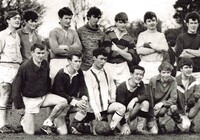 Comhairle Teachta na Mic Léinn (UCG Students Council) 1969
This is the 1969 CTM (Students Council) soccer team taking part in a Students Vs. Staff football match as part of the very first College Week in 1969. College Week replaced RAG Week, which the Bishop of Galway banned in the 1950s.
-
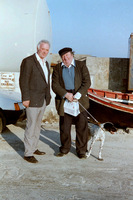 Pádraig Ó Céidigh at book launch on Aran, April 1994
Pádraig Ó Céidigh was one of the many staff of NUI Galway who attended the launch of 'The Book of Aran' on a particularly fine day. He is holding a bag with the words 'Aran Heritage Centre' and has probably bought the book. He was a noted Marine zoologist and very much at home in this type of setting. He is accompanied y the inevitable dog.
Note the car parked in front of the no-parking sign.
-
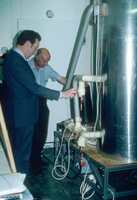 Inspecting Physics equipment, 1982
Tom O'Connor (left) and Frank Gaffney inspecting some equipment, most probably connected with Atmospheric Physics research.
-
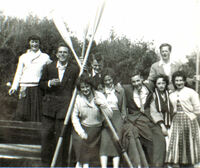 UCG students by the Corrib, 1955
Taking a boat up the Corrib to relax has been one of the pleasures of student life over many decades.
The location of the University, with its main campus now stretching along the Corrib from Beggars Bridge to the playing fields near Menlo Castle has meant that the Boat Club has always been one of the most popular clubs in the University.
-
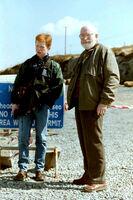 Breandán Ó Madagáin and his son on Aran, 1994
This photo of Breandán Ó Madagáin and his son was taken on the day of the launch of 'The Book of Aran'.
A noted Celticist and Irish scholar, Breandán Ó Madagáin (1932–9 January 2020) was originally from Limerick. He was a lecturer in Irish in UCG and then, from 1975 until his retirement in 1997, he was Professor and Chair of Irish there. His range of expertise covered folklore, sociolinguistics and Gaelic manuscript traditions.
His published work included several monographs: Teagasc ar an Sean-Tiomna (Teaching on the Old Testament), 1974; An Ghaeilge i Luimneach (The Irish Language in Limerick) 1974; Caointe and Seancheolta Eile/Keening and Other Old Musics, 2005. In 1978 he edited Gnéithe den Chaointeoireacht (Aspects of Keening). 'He was deeply interested in the connections between the traditional poetry of Gaelic society and its integral connection to song, writing several substantial articles on this topic ' (Ó Laoire, 2022).
In 1992 he was elected a member of the Royal Irish Academy, and from 1995-2005 he served as Chair of the Board of the Dublin Institute of Advanced Studies.
-
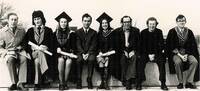 Physics graduates, 1976
Among those pictured here are Tom O'Connor, Lecturer in Physics (1st on left) and Frank Imbusch, Professor of Physics (4th from left).
-
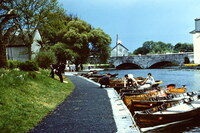 UCG Boat Club, 1959
This photograph, taken in spring 1959, shows how the Boat Club was always a valued amenity just beside the main university buildings.
-
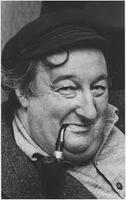 Prof. Pádraig Ó Céidigh
Pádraig Ó Céidigh (1933-2008) was the first Professor of Zoology and head of department the University of Galway from 1962 until his retirement in 1999.
-
[Untitled]
-
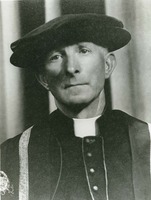 Monsignor John Hynes (Seán Ó hEidhin)
This is a studio portrait of Monsigor John Hynes (Seán Ó hEidhin), at the time he was appointed as college president in 1934. He served until 1935. Affectionately known as 'Pa Hynes' to students, Monsigor Hynes was popular with students and staff and had already served in a number of capacities within the college. In 1911 he had been appointed dean of residences at UCG, before being appointed secretary in 1914 and registrar in 1916. In 1924 he became professor of archaeology, a position he retained when he assumed the role of president.
-
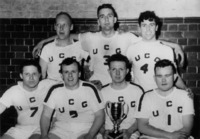 UCG 1950-1955 Intervarsity Basketball Champions
This image is of the UCG Basketball team, who were Intervarsity Basketball Champions from 1950-53. The team was largely comprised of American students who had come to UCG to study Medicine in the post-WWII period, some of them as part of the G.I. Bill. The only non-American in the group is John McLoughlin, who was from Liverpool. The team persuaded one of their landladies to cut out the letters and numbers in maroon-coloured fabric, and sew them onto their white t-shirts, ensuring that the team made quite an impression on their opponents from the other Irish universities.
-
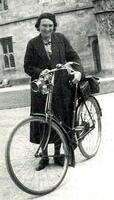 Margaret ('Ma') Heavey / Mairéad Ní Éimhigh
This is Margaret Heavey (Mairéad Ní Éimhigh; earlier Mairghréad Ní Éimhthigh), Lecturer in Ancient Classics (1931-58) and then Professor of Ancient Classics (1958-77), perhaps the most fondly remembered of the academic staff of the College of that era. She was also Dean of the Faculty of Arts (1970-76). She was regarded by many as the living embodiment of the caring University - the alma mater - a regard reflected in her being commonly known as 'Ma' Heavey. She was also the first woman to have a building on campus named (posthumously) in her honour - Áras Ní Éimhigh, the former Coffee Shop, then converted to the Press Office.
The bicycle shown was, at the time of the photograph (probably the 1930s or the early 1940s), her daily mode of transport from Athenry, where she lived, when, as Christy Townley recalled, the train was not operating, as frequently happened during the Second World War Years; when it was, she used the bicycle between the rail station and the College. She often came to the Library (in the Quadrangle), where he worked, around 7pm to get assistance from him in the delicate task of preparing the carbide lamp, shown in the photograph, for the bicycle for the long, lonely journey on the rough road back to Athenry in winter time.
In 1931, in pursuit of the College's new role, agreed with the Government, in relation to Irish-language University education, Margaret Heavey and Seoirse Mac Tomáis (George Thomson) were each appointed to a Lectureship in Ancient Classics. In practice, she focused on Latin and he on Greek, but, when he resigned in 1934, she had to handle both aspects.
-
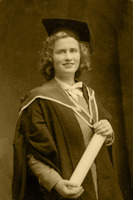 Eibhlín Uí Chionna (née O'Malley)
 on her graduation day as a B.Sc.(Hons) in 1945. Eibhlín O'Malley was a daughter of Dr. Michael O'Malley, Professor of Surgery at UCG for many years. She was one of six of the seven children of Professor O'Malley who took degrees from UCG. She subsequently undertook post-graduate studies in the United States, qualified as a dietician, and later taught Physics at the Royal College of Surgeons. Her sister, Dr. Ethna Gaffney (née O'Malley), also a UCG graduate, was Professor of Chemistry at the Royal College of Surgeons at the same time, and was the first female professor at the RCS.
