-
 Tom O'Connor with President Ó Tnúthail, 1961
This photograph was taken on the day on which a doctorate in Physics was conferred on Tom O'Connor for his thesis entitled 'The measurement of the size and concentration of condensation nuclei'. He had been a lecturer in UCG since 1956 and was to become a significant figure in the development of his discipline there.
The trees and branches lying in the background are probably the result of Hurricane Debbie which struck the west of Ireland on 16 September 1961, causing widespread damage.
-
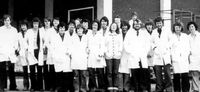 Microbiology students on a visit to a dairy
The dairy seen here may be Michelstown Dairy.
The only person who has been identified is John Patching with beard and glasses in the front row.
-
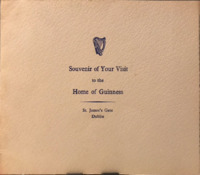 Souvenir of a visit to the Guinness Brewery
Cover of a folder holding a photograph offered as a memento of a visit to the Guinness Brewery, mid 1970s.
-
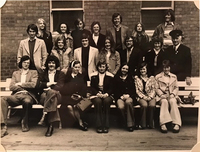 Microbiology class at the Guinness brewery, mid 1970s
John Patching records that this photograph was take during an educational tour for Microbiology students some time around the mid 1970s.
Four of the students here have been identified:
Fergal O’Gara, later Professor of Microbiology in UCC and father of Ronan of rugby fame, is third from the left in the second row. Next to him are Victoria Garrod (later Buckley) and Chris Buckley. John Patching (with a beard), later professor of Marine Microbiology in NUI Galway, is third from the right in the second row.
-
 Pádraig Ó Céidigh and his dog on Aran, 1994
Pádraig Ó Céidigh (Paddy Keady), professor of Zoology in NUIG, and a specialist of marine biology, was frequently accompanied by his dog. They are seen here beachcombing during a break in proceedings at the launch of the 'Book of Aran'.
This is one of 33 photographs taken by Frank Imbusch at the launch.
-
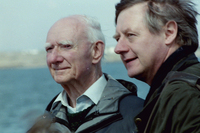 John de Courcy Ireland and John Waddell, Aran, 1994
John de Courcy Ireland, noted maritime historian and political activist, and John Waddell, lecturer and later professor of Archaeology in NUIG, are seen here at the launch of the 'Book of Aran' on Inishmore.
This is one of 33 photographs taken by Frank Imbusch on that day. John de Courcy Ireland was a contributor to the book, which was edited by A. Korff, J. Waddell and J.W. O'Connell.
-
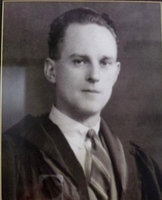 Labhrás Ó Nualláin, MEcon, UCD
This photograph of Labhrás Ó Nualláin (1912-2000) was taken at his Master of Economics graduation in 1945. In the same year he was awarded a BA from Trinity College Dublin. Both degrees were undertaken when he had already started a family and was working in the Employment Exchange in Dublin. In 1953 he took up a lectureship in Economics in UCG, where in 1970 he was appointed to the Chair of Economics.
-
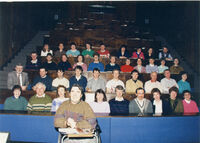 Evening BA class, early 1980s
, seated in a lecture theatre with Hubert McDermott
-
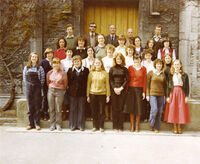 Evening BA class with Department of English staff, early 1980s
Evening BA class with three academic staff from the Department of English in front of the Aula Maxima, Quadrangle, UCG.
-
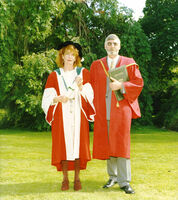 Edna O'Brien, DLitt honoris causa, 1991
Edna O'Brien on July 1, 1991 , following conferral in UCG of the honorary degree DLitt on her by the NUI, on the proposal of UCG, with Professor Hubert McDermott, Department of English, who had delivered the citation contained in the folder in his hand. The photograph was taken in the President's garden behind the southwest corner of the Quadrangle.
This was the first honorary degree conferred on Edna O'Brien by any University. It was generally seen as overdue recognition of a writer whose controversial early novels in the 1960s, rooted in the religion-dominated Irish rural society of her girlhood, had been banned in Ireland. A photograph of her chatting on this occasion with the Bishop of Killaloe, Most Rev. Dr Michael Harty, who was Clare Co. Council's representative on the Governing Body at the time, was thus seen by many as reflecting the change in Irish society since that time. That belated sense of acceptance was echoed in Miriam Lord's report, following her interview of Edna after the conferral, under the headline 'Country Girl Goes Home', published in the Irish Independent of July 2, 1991.
-
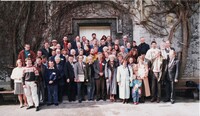 Nordic-Celtic Legend Symposium in UCG, 1991
A Nordic-Celtic Legend Symposium took place in UCG, Mar. 1991. The event was inspired by a symposium on Irish and Scottish migratory legends held in UCD in 1988, and in turn, the 2nd such Conference held in Galway became the inspiration for an expanded Nordic-Celtic-Baltic conference held in the University of Copenhagen in 1993. Those with UCG affiliations in the group conference picture included Mícheál Mac Craith (3rd from left in front row), Séamas Ó Catháin (6th from left in front row), Pádraig Ó Héalaí (7th from left in front row), Mark Wringe (3rd from the right in the row above the front row), and Lillis Ó Laoire in the 2nd row from the top, and to the right of the person with a blue top - they all were in the Dept. of Nua-Ghaeilge, Ollscoil na Gaillimhe.
The Conference picture also included Bo Almqvist (2nd from the right in the front row), Dept. of Folklore, UCD and many other folklore scholars from a range of countries. The conference papers dealing with the history, function and form of folk legends in the relevant geographical areas were subsequently published in Béaloideas, Vols. 60-3, 1992-5.
-
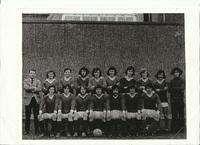 UCG Sigerson Cup team, mid-1970s
UCG Sigerson Cup team of the mid-1970s.
-
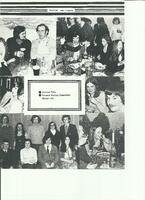 Science Party & Science Society Committee,1970s
Photos taken at a Science Faculty student party and one photo of the Committee of the Science Society
-
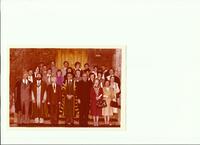 Castlebar Extramural Studies Diploma graduates at Conferral, early 1980s
The Castlebar Extramural Studies Diploma class in the Quadrangle of UCG following conferral of their Diploma, together with academic and other education officers and the Mayor of Galway
-
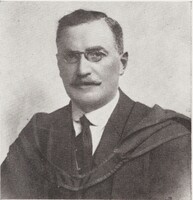 Frank Sherman Rishworth, 1924
Frank Sherman Rishworth, son of John Rishworth and Hannah Sharman of Ballymoate House, Tuam was born on 5 April 1876. He entered Queen’s College Galway in 1899 and graduated with B.E. and B.A. degrees in 1898 and 1899 respectively. Following employment with the Egyptian Public Service he was appointed Professor of Civil Engineering at University College Galway in 1910 and he retired in 1946. He died on 31 March 1960.
During his tenure as Professor of Civil Engineering, University College Galway were persuaded to release Frank Rishworth to act as Chief Civil Engineer on the Shannon Hydro-Electric Scheme. On completion of the Shannon Scheme in 1929, Rishworth returned to UCG, but resided in Dublin. He retired from UCG in 1946. He died on 31 March 1960. Further details of his career are described by Paul Duffy (Paul Duffy, 'Engineering', 1999, pp 125-411).
-
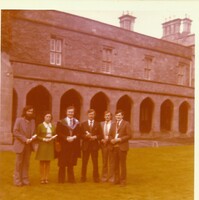 Extramural Studies Diploma group, early 1980s
Extramural Studies Diploma group in the Quadrangle following conferral of their Diploma
-
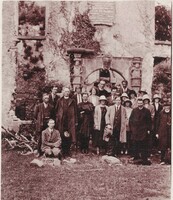 Group outing to Menlo Castle, 1924
The picture shows a group of twenty two people outside the ornate frontal façade of Menlough Castle, locally more usually referred to as Menlo Castle (Sites and Monuments Record Number GA082-064). It is located alongside the river Corrib, and about 5 km north - northwest of Galway City. The group include Rita Carlos and Patt Larkin, graduates of UCG, in the second row from the top, positioned 5th and 6th respectively from the left hand side.
Menlough Castle, locally referred to as Menlo Castle (SMR GA082-064), is a ruined but picturesque castle on the eastern bank of the river Corrib, a short distance south of Menlough Village. “Menlo” was the usual spelling of the name in all the Blake family records. The original castle building was a long, rectangular 16th century hall-house, later bearing Dutch gables, measuring 22.6m x 9.2m, of two or more storeys (1720 – Menlough Castle, Galway | Archiseek - Irish Architecture) . The eastern frontal façade, latterly modified to contain six bays, had battered walls, a centrally located porched doorway insert, a wallwalk parapet with Dutch gables, bearing a bartizan at each corner, and a tall chimney on each end-wall, only one of which survives. The original doorway was retained on the south side, close to the south-east corner. The new front doorway entrance was enhanced by the addition of an ornate 17th century styled porch, which was removed from the building c. 1930. It, or a facsimile, is now located at the Falconry at Kylemore Abbey. All four of the corner bartizans are intact and still in situ, one of them incongruously incorporated into the later manor house extension to the west. The original castle was extended and much altered c. 1720, by the addition of a battlemented manor house and turret to the west.
Menlo Castle is said to have been constructed in 1569, according to Blake family records (In conversation with Mr. Bruce St. John Blake, a past President of the Law Society of Ireland, d. April 2019) . This most likely refers to the hall-house described above, but possibly to an earlier, more basic castle east of the existing site. Remnants of that structure are likely to have provided the core of the Tea-Room folly on the west bank of the Corrib, opposite Menlo Castle.
In the defining list of castles in County Galway dated 1574 (See Colonel J.P. Nolan M.P., in JGAHS Volume 1, Part II, p. 109), Menlo Castle is mentioned (Mynlagh) as having been in the possession of one Thomas Colman (Thomas Colman was a Public Notary in Galway, witnessing numerous Blake family legal instruments between 1549 and 1564. As effectively the Blake family solicitor, it is likely that his possession of the castle was for and on behalf of the Blakes at a time when prudent Catholics would minimise their property portfolios). He was effectively the Blake family solicitor, and it is likely that his possession of the castle was for and on behalf of the Blakes at a time when prudent Catholics would minimise their property portfolios. However, the castle was in the possession of the Blake family by the turn of the 17th century, who then made it their main seat in Galway. The first occupant was Sir Valentine Blake, (1560 – 1635), merchant and Mayor of Galway, declared the richest man in the town by 1592 (Martin J. Blake, Blake Family Records, Part I, p.104, Record 133). He was created Baronet of Menlough on July 10th 1622, and married firstly Margaret Ffrench, and secondly Annabel Lynch, so he did not lack connections. After four centuries of residence there, the castle was in the possession of the 14th Baronet, again Sir Valentine Blake (1836 – 1912). In a tragic accident, the castle burnt to the ground on 26th July 1910 with loss of life. The Blake family left the site, and never returned.
-
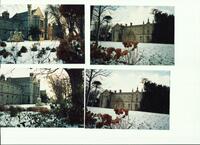 The Quadrangle in Snow, pre-1985
Four images of the West wing of the Quadrangle of the University of Galway in snow, pre-1985
-
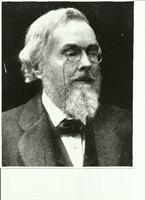 George Sigerson
 (1836-1925), who graduated MD (1859) and MCh (1865) from Queen's College, Galway. He won a First-Year Scholarship in the Faculty of Medicine for the 1855-56 Session. He was later Professor of Zoology in UCD, a Fellow of the Royal University of Ireland and a member of the Senate of the NUI. A physician, scientist, poet, author and political journalist, he was a significant figure in Irish literary and cultural life. In 1911 he purchased a trophy, called the Sigerson Cup, for competition in Gaelic Football between the three NUI Colleges. The first winners were UCC, followed by UCG in 1912. Subsequently QUB took part, and later the competition was extended to all Universities and, in the 1990s, to all third-level institutions. It has been long recognised as the top Gaelic Football competition at third level.
-
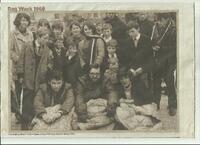 Rag Week, 1969 - Sleep-in
A fundraising charity sleep-in at Eyre Square, Galway during UCG Rag Week in February 1969. Two of the group are wearing the UCG scarf of maroon, white and green.
-
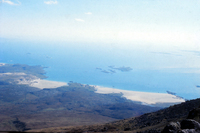 View of beaches from the top of Mweelrea, c. 1976-1978
This is a view west from Mweelrea (Cnoc Maol Réidh) towards Doovilra, Uggool, Inishdegilmore and Inishdegil Beg. At 814m the summit of Mweelrea is the highest point in Connacht.
In 2022 Michael Kane gave a vivid account of the activities of the Mountaineering Club in its early days. See 'Michael Kane's account of the Mountaineering Club c. 1971-72'.
The Mountaineering Club was established in 1970. Its membership in 2023 was over 1000.(Mountaineering Club, 'About us'). The Library archives contain a number of documents relating to the club. These were placed in the care of the University by Aengus Finnegan, Secretary 2010-2011 (Mountaineering Club, 'Archive').
-
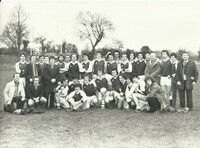 UCG Sigerson Cup Champions, 1979-80, in Bellaghy following victory
The victorious UCG Sigerson Cup team, with mentors and others, in Bellaghy in February 1980 immediately after defeating UCD in the final by 1-8 to 0-7. See the 'UCG Sigerson Cup Champions, 1979-80' image for further information.
-
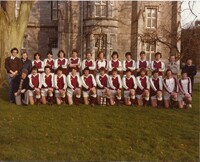 UCG Sigerson Cup Champions, 1979-80
The UCG team who won the Sigerson Cup in Bellaghy in February 1980, defeating UCD 1-8 to 0-7 in the final and thus depriving them of a fourth successive title. UCG went on to win four titles in five years (1979-80 to 1983-4) and were only deprived of five-in-a-row by QUB (the hosts) in 1981-82 following extra time. The winning captains were Pádraig Monaghan (Garrymore) in 1979-80, Gay McManus (Milltown) in 1980-81, Richie Lee (Maigh Cuilinn) in 1982-83 and Tomás Tierney (Milltown) in 1983-84, and the coach was Tony Regan. This photo was taken outside the President's Office in the West wing of the Quadrangle.
-
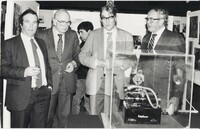 Irish Folklore Exhibition, 1986
The picture shows the following persons (l to r): Pádraig Ó Héalaí; Breandán Ó Madagáin; Bo Almqvist; and An Dr Colm Ó hEocha, President of University College Galway. The picture was taken during the launch in University College Galway, spring of 1986, of an exhibition entitled 'I gCuimhne na nDaoine' on loan from the Dept. of Irish Folklore, UCD, portraying the work of the Irish Folklore Commission (1935-70).
Pádraig Ó Héalaí was Senior Lecturer le Nua-Ghaeilge (1981-2006) at University College Galway (UCG).
Breandán Ó Madagáin was Ollamh le Nua-Ghaeilge (1975–97) also at UCG.
Bo Almqvist, was Professor of Irish Folklore (1972-95) at UCD and Director of the Irish Folklore Archive - later the National Folklore Collection – Cnuasach Bhéaloideas Éireann.
Dr Colm Ó hEocha was President of University College Galway from 1975 to 1996.
The exhibition also included an Ediphone, a clockwork dictating recording machine using wax cylinders, and used by collectors on behalf of the Irish Folklore Commission, to record tales and traditions which were later transcribed.
-
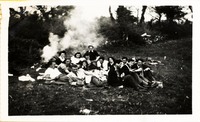 Archaeological outing, 1946 or 1947
This photograph was taken on an archaeological outing in 1946 or 1947. Daiden Fahy, later Ó hEocha, dressed in a light colour, is second from the left near the back of the group.
