
Items
Contributor is exactly
Patrick Larkin
-
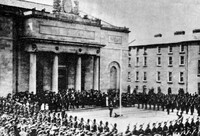 Galway Courthouse 1910, King George V Proclamation The accession of King George V to the throne was proclaimed in Galway Courthouse at 2 pm on 21 May, 1910, following the death of Edward VII. The ceremony was performed by the High Sherriff, Mr. Cecil R. Henry (www.kennys.ie, 2016). A picture shows the scene outside of Galway Courthouse (Semple, 1969). About one hundred men of the Connaught Rangers, under Major Sarsfield, were formed up in line opposite the Courthouse, and an equal number of the Royal Irish Constabulary (www.kennys.ie, 2016), whose bayonets are shouldered, and under the command of the Head Constable, Charles Carlos. Family tradition (P. Larkin, personal communication) has it that the two white figures at the base of the Courthouse steps in the picture were likely Charles Carloss’ daughters – Rita and Nina Carlos. Their confirmation picture in about 1910-12, with Rita on the left, is also shown. That picture was taken In Slater's Studio, Ballina, Co. Mayo in the period between 1910 - 12, (P. Larkin, Personal communication).
-
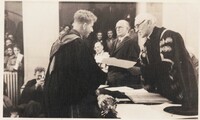 Kevin Larkin, Graduation in 1955 The picture shows Kevin Larkin receiving the B.E. degree parchment from the President of University College Galway (UCG), Revd Monsignor (Msgr.) Pádraig de Brún, M.A., D.Sc. The Registrar of the National University of Ireland, Séamus Wilmot is alongside the President. Patt Larkin, Prof. of Education can be seen to the left of the picture, taking a picture of his son Kevin. The University’s mace can be seen on the table. Revd Msgr. Pádraig de Brún was formerly Professor of Mathematics at the University of Maynooth. He succeeded Msgr. John Hynes as President of UCG in April 1945 and he retired in 1959, due to illness. He passed away on 5 June 1960. Additional information of his life and career is presented by Lawrence William White in the Dictionary of Irish Biography (www.dib.ie/biography/de-brun). Séamus Wilmot, a native of Listowel, Co. Kerry, B.A., B.Comm., H. Dip. in Ed., L.L.D. (jure officii), was appointed Registrar of the National University of Ireland, by the Senate, on December 11th, 1952. He retired on May 4th, 1972. He died on January 1st, 1977 (www.nui.ie/about/registrar).
-
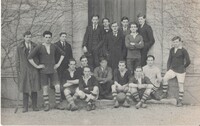 Gaelic Football, UCG in 1920 The picture shows seventeen men, all young with the possible exception of one person. Seven of the group are wearing football socks and one has a football balanced between his legs, with the inscription ‘UCG-1920-‘. One person appears to be holding a hurling stick. Some of the persons are semi-formally dressed with ties or bow ties.
-
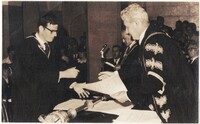 Patrick Larkin Graduation, 1966 The photograph shows Patrick Larkin receiving the B.Sc. degree from Dr Martin Newell, President of UCG. Prof. Cilian Ó Brolcháin to the right of President Newell, was acting in his capacity as Dean of the Faculty of Science. Martin J. Newell, was Professor of Mathematics in University College Galway (1955 -1960) and he was appointed President of University College Galway in 1960 and he retired from the post in 1975. Cilian Ó Bhrolcháin, was appointed Professor of Experimental Physics in 1934 and he resigned from the post in 1973 (Tom O’Connor, 'Natural Philosophy / Physics’).
-
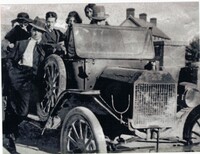 Motor vehicle on Beggars Bridge, 1921 The picture shows (l to r) the following persons: Charlotte Carlos; vehicle driver; Patt Larkin; Rita Carlos; Nina Carlos; and Charles Carlos in / alongside a Model T Ford motorcar. The vehicle was located on Beggars Bridge (as written on the back of the photograph) at the UCG Rowing club. The Model T Ford motorcar was complete with removable acetylene lamps and was hired from Flaherty Motors. Charlotte Shortle Carlos and Charles Carlos were the parents of Margaret (Rita), and Mary Josephine (Nina). Rita married Patt Larkin, Prof. of Education, UCG and Nina married Tom Dinan, Prof. of Natural History, UCG.
-
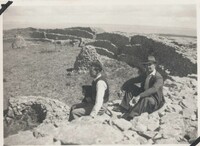 Inishmaan stone fort, 1948 The photograph shows Patt Larkin, Prof. of Education, UCG (on the left of picture) with Mr. McGinley, a kelp inspector, on Dún Conor (Dún Chonchúir) on Inishmaan, Aran Islands. Dún Conor (Wikipedia_Conor, 2023) is a stone ringfort with partly rebuilt (by the OPW (Office of Public Works) ‘clocháns’ or stone houses. The three-stage, dry-built rampart is probably pre-Christian in foundation. The kelp industry was important to the subsistence economy in the Aran Islands. Images of large piles of seaweed drying, prior to its burning for the iodine industry, are shown in the Chambers Archive, held by Galway County Council (Galway County Council Archives, 1929-1938); (J. Higgins,1931, pp 59 – 72). The seaweed was collected from rocks after the storms of autumn and winter, dried on fine days, and then made up into a rick, where it was left until the beginning of June. It is then burnt in low kilns on the shore, a process that takes from twelve to twenty-four hours of continuous hard work. The kiln holds about two tons of molten kelp, and when full it is loosely covered with stones and left to cool. In a few days the substance is as hard as the limestone and has to be broken with crowbars before it can be placed in curraghs for transport to Kilronan, where it is tested to determine the amount of iodine it contains and paid for accordingly. In former years good kelp would bring seven pounds a ton, now four pounds are not always reached (J. Higgins,1931, pp 59 – 72). The income gleaned from its collection, burning, sale and transport was significant for the Islanders (D. Fitzpatrick, 2012). In former years, good kelp would bring seven pounds a ton, now four pounds are not always reached (J. M. Synge,1907, pp 194-5).
-
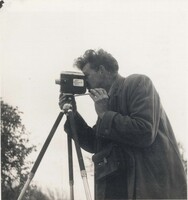 Taking a picture in Aran, 1954 Patt Larkin, Professor of Education, visiting the Aran Islands in 1954 as a member of the Education Film Unit (Aonáid Scannáin, Ollscoile na Gaillimhe). The picture shows Patt Larkin taking a picture with a camera mounted on a tripod. It was an 8mm movie camera.
-
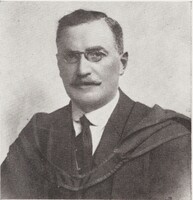 Frank Sherman Rishworth, 1924 Frank Sherman Rishworth, son of John Rishworth and Hannah Sharman of Ballymoate House, Tuam was born on 5 April 1876. He entered Queen’s College Galway in 1899 and graduated with B.E. and B.A. degrees in 1898 and 1899 respectively. Following employment with the Egyptian Public Service he was appointed Professor of Civil Engineering at University College Galway in 1910 and he retired in 1946. He died on 31 March 1960. During his tenure as Professor of Civil Engineering, University College Galway were persuaded to release Frank Rishworth to act as Chief Civil Engineer on the Shannon Hydro-Electric Scheme. On completion of the Shannon Scheme in 1929, Rishworth returned to UCG, but resided in Dublin. He retired from UCG in 1946. He died on 31 March 1960. Further details of his career are described by Paul Duffy (Paul Duffy, 'Engineering', 1999, pp 125-411).
-
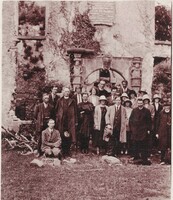 Group outing to Menlo Castle, 1924 The picture shows a group of twenty two people outside the ornate frontal façade of Menlough Castle, locally more usually referred to as Menlo Castle (Sites and Monuments Record Number GA082-064). It is located alongside the river Corrib, and about 5 km north - northwest of Galway City. The group include Rita Carlos and Patt Larkin, graduates of UCG, in the second row from the top, positioned 5th and 6th respectively from the left hand side. Menlough Castle, locally referred to as Menlo Castle (SMR GA082-064), is a ruined but picturesque castle on the eastern bank of the river Corrib, a short distance south of Menlough Village. “Menlo” was the usual spelling of the name in all the Blake family records. The original castle building was a long, rectangular 16th century hall-house, later bearing Dutch gables, measuring 22.6m x 9.2m, of two or more storeys (1720 – Menlough Castle, Galway | Archiseek - Irish Architecture) . The eastern frontal façade, latterly modified to contain six bays, had battered walls, a centrally located porched doorway insert, a wallwalk parapet with Dutch gables, bearing a bartizan at each corner, and a tall chimney on each end-wall, only one of which survives. The original doorway was retained on the south side, close to the south-east corner. The new front doorway entrance was enhanced by the addition of an ornate 17th century styled porch, which was removed from the building c. 1930. It, or a facsimile, is now located at the Falconry at Kylemore Abbey. All four of the corner bartizans are intact and still in situ, one of them incongruously incorporated into the later manor house extension to the west. The original castle was extended and much altered c. 1720, by the addition of a battlemented manor house and turret to the west. Menlo Castle is said to have been constructed in 1569, according to Blake family records (In conversation with Mr. Bruce St. John Blake, a past President of the Law Society of Ireland, d. April 2019) . This most likely refers to the hall-house described above, but possibly to an earlier, more basic castle east of the existing site. Remnants of that structure are likely to have provided the core of the Tea-Room folly on the west bank of the Corrib, opposite Menlo Castle. In the defining list of castles in County Galway dated 1574 (See Colonel J.P. Nolan M.P., in JGAHS Volume 1, Part II, p. 109), Menlo Castle is mentioned (Mynlagh) as having been in the possession of one Thomas Colman (Thomas Colman was a Public Notary in Galway, witnessing numerous Blake family legal instruments between 1549 and 1564. As effectively the Blake family solicitor, it is likely that his possession of the castle was for and on behalf of the Blakes at a time when prudent Catholics would minimise their property portfolios). He was effectively the Blake family solicitor, and it is likely that his possession of the castle was for and on behalf of the Blakes at a time when prudent Catholics would minimise their property portfolios. However, the castle was in the possession of the Blake family by the turn of the 17th century, who then made it their main seat in Galway. The first occupant was Sir Valentine Blake, (1560 – 1635), merchant and Mayor of Galway, declared the richest man in the town by 1592 (Martin J. Blake, Blake Family Records, Part I, p.104, Record 133). He was created Baronet of Menlough on July 10th 1622, and married firstly Margaret Ffrench, and secondly Annabel Lynch, so he did not lack connections. After four centuries of residence there, the castle was in the possession of the 14th Baronet, again Sir Valentine Blake (1836 – 1912). In a tragic accident, the castle burnt to the ground on 26th July 1910 with loss of life. The Blake family left the site, and never returned.
-
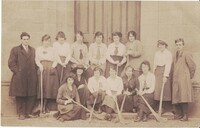 Camogie Group, 1920 The picture shows a group of thirteen camogie players which include Cissie Byrne and Rita O'Hara. Eight are wearing white tops, some with ties. The group includes two men, wearing overcoats and ties. Mary Margaret (Rita) O’Hara came to University College Galway in 1918 and studied Science. She passed 1st Science in 1919. She retired from the B.Sc. Exmination in the Summer of 1921. She completed her B.Sc. Degree in the Autumn of 1922, following the examination in Mathematical Physics (Tortha na Sgrúdú,1918-23).
-
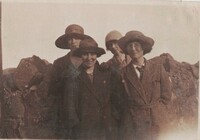 The Hillsiders, 1921 The picture shows four women (l to r): Bee Cafferkey, Ciss Byrne, Nina Carlos and Rita Carlos, with a hill in the background. Some are wearing overcoats (one belted) with hats and a cap. It appears that they were out hill walking and were known as ‘The Hillsiders’. Bee (Bridget) Cafferkey won a Mayo County Council Scholarship in 1918 and came to University College Galway. She did Arts, obtaining high grades in the 1st Arts Examinations in Summer 1919. She took French as a BA Subsidiary subject in 1920. She obtained a 1st Class Honours BA Degree in Irish and in English in the autumn of 1921.
-
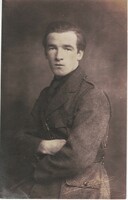 Jack Lohan, UCG Engineering student, 1919 and IRA Volunteer John Joseph (Jack) Lohan was born on 19 March 1902 at Raven Terrace, Galway. In 1919 he was awarded a Galway County Council Scholarship to University College Galway, where he studied Engineering and Science. However he failed his examinations in 1920 and in the Summer of 1921 - he was absent for the Autumn Examinations. He was attached to the Galway City Company IRA and was shot dead by members of the Free State Army on 24 September 1922 (Coláiste na Ollsgoile Gaillimh - Tortha na Sgrúdú, 1918-23). His picture was taken in C J Leaper's photographic studio in Nun’s Island Galway. C.J. Leaper wrote a book entitled ‘Experimental Photography’, published in 1890. Jack Lohan was the second child and eldest son, born on 19 March 1902 in Raven Terrace, Galway to parents Michael Lohan and Annie Gannon, both National School teachers. The family later lived in Woodquay, Galway. Following his primary education at Bohermore National school, where his father taught, he attended St. Mary’s College Galway. He obtained a Galway County Council Scholarship to University College Galway in 1919, where he studied Engineering. The Examination results for 1920 show that Jack failed in both 1st Engineering and in 1st Science. He also failed 1st Engineering in the summeer of 1921 and was absent for Autumn examinations. Jack Lohan was attached to the Galway City Company IRA during the War of Independence (1919–21). He took the anti-treaty side in the ensuing Civil War. He was shot dead at McHugh’s public house on the Tuam road on 24 September 1922 (Connacht Tribune, issue of 30 Sep. 1922), (B. McGowan, Galway City Museum), (https://galwaycitymuseum.ie_seaghan-o-lochain-1902-22). He was buried in the New Cemetery, Bohermore, Galway. His name ‘An Caiptín Seán Ó Lócáin’ is inscribed on the Republican monument off the Tuam road, Castlegar, Galway.
-
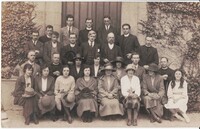 Higher Diploma in Education Class of 1923 The picture shows the graduation class of the Higher Diploma in Education in 1923. It also includes some staff including Fr. Tomás Ó Ceallaigh, first Professor of Education at University College Galway. Fr. Tomás Ó Ceallaigh was Professor of Education at the time of the graduation of the Higher Diploma in Education class of 1923. He is likely to be in the second row from the top, third from the left and holding a hat – this is reasonably consistent with the writing at back of the photographic postcard which reads ‘Father O’Kelly, the celebrated Professor and writer of Neo-Celtic Opera is to be seen in this photo in one of his characteristic moods (Daily Mail, Jul. 1923). Graduands included Patt Larkin, on the left in the top row; Rita Carlos (fifth from the left in bottom row) and Frances Moffett (sixth from the left in bottom row). Tomás Ó Ceallaigh was born in Gurteen, Co. Sligo on 15 December 1879. At the age of thirteen he won first place in a scholarship examination to Summerhill College, Sligo. Later, in 1897, he went as a clerical student to Maynooth College, was ordained priest in 1903, and after the award of the Licentiate in Theology degree returned to Summerhill College where he taught until 1912. In 1908, he obtained a Bachelor of Arts degree at the National University of Ireland, and from 1913 to 1914 studied in University College Dublin where he was awarded the Higher Diploma in Education He was appointed as first Professor of Education at University College Galway in 1914. Ó Ceallaigh came to Galway with the reputation of a scholar, an outstanding, experienced teacher, and a writer, especially in Irish. He was awarded the M.A. Degree in University College Dublin in 1922. He became very ill in 1923 and his doctor advised him to go to France. He left Galway on Feb. 4th 1924. Within three weeks, on 24 February, Ó Ceallaigh died in France, in San Roche Hospital, Nice and he was buried in Nice Cemetery. He was succeeded in the position of Chair of Education by Patt Larkin in 1925 (E. Ó Héideáin, History of Education, 1968-88), (www.universityofgalway.ie/ school-of-education).
-
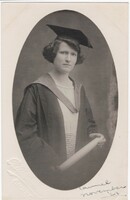 Carmel Hibbett Graduation, 1922 Carmel Hibbett graduated with a Commerce degree at University College Galway in Nov. 1922 (UCG Calendars). Carmel Hibbett was a daughter of Thomas Bernard Hibbett and Elizabeth Lucy Rushe. Carmel was born in Kilconnell, Co. Galway on 2 Dec. 1899 (Killure-Kilgerrill, 2022). She was a student at University College Galway from 1919 to 1922. She obtained her Commerce degree in the autumn of 1922. She passed away on 23 Oct. 1989 in Dublin (www.irishgenealogy.ie).
-
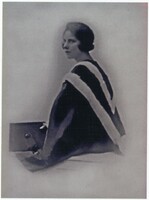 Mary J (Nina) Carlos Graduation in 1923 Mary Josephine (Nina) Carlos went to UCG in 1920 having obtained an Ordinary Entrance Scholarship to U.C.G. and she graduated in 1923 with a 1st Class Honours BA degree and a B.Comm degree in the same year, followed by a Higher Diploma in Education with Second Class Honours in 1924. She married Prof. Tom Dinan on 17th September 1942. Nina Carlos Dinan died on 2nd September 1984. Further details of her life are described (Patrick Larkin, Asset Id 13737).
-
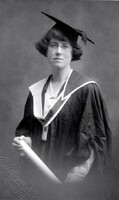 Rita Carlos Graduation in 1922 Margaret (Rita) Carlos entered UCG in 1919 and graduated with a 1st Class Honours BA degree in 1922, followed by a Higher Diploma in Education in 1923. She married Patt Larkin on 3rd September 1926 and had nine children. Rita Carlos Larkin died on 1st April 1987. Margaret (Rita) Carlos was born in Woodquay, Galway on 7 Sept. 1900 to Charles Carlos and Charlotte Shortle. She was the eldest of six children, two of whom were lost in the Spanish Flu epidemic. Her father, Charles, was an RIC officer who rose to the rank of Head Constable before his transfer out of Galway. He retired from the R.I.C. in 1912, and moved the family to Ballina, where he changed career to become an Income Tax Collector and Estate Agent. Her mother, Charlotte, was a National School Teacher and held several teaching posts in the west of Ireland, the final posting in Belmullet, Co. Mayo. Rita and her siblings attended school at St. Mary’s Mercy Convent in Ballina. In due course, as the country became more unsettled during the War of Independence, the two older girls, Rita and Nina, were moved to Dublin to board at the Dominican convent in Eccles Street. Rita showed much promise at this school, winning several school prizes, and publishing essays in prose and poetry in a variety of publications. She attended a sitting of the First Dáil on the 10th of April in 1919. The two sisters completed their education in Eccles Street, Rita in 1919 and Nina in 1920. Rita returned to Galway in 1919, winning an Ordinary Entrance Scholarship to U.C.G. for the 1919-20 session. In July 1919, as part of her entrance examination, Rita was the winner of the Peel Prize in English, achieving the highest marks ever awarded for that distinction. In 1922, her B.A. degree examination was considered brilliant, and she won first place, attaining First Class Honours on a very high percentage. She partook in all the usual student activities, and played Camogie for the college. She enjoyed rowing on the Corrib, also was an avid collector of photographs, especially of her family and friends. She followed her B.A. Degree by studying for the Higher Diploma in Education (H. Dip.), which she was awarded with 2nd Class Honours in 1923. She taught at the Presentation Convent in Galway as part of her H.Dip. studies during 1922-23. She was preparing her thesis for M.A. in 1923, but interrupted her studies when an unexpected opportunity arose. Her professional teaching career began at the newly founded Benedictine Abbey at Kylemore, where the Irish Dames of Ypres found a home after their convent in Belgium suffered wartime demolition. Rita was the first teacher employed there, specialising in French and English; and spent the school year there in 1923-24. The following year she moved to Britain, and secured a position at the Bar Convent in Blossom Street, York city, run by the Congregation of Jesus, for 1925. The following academic year (1926), she took a short-term position at Saint Michael’s College in Irvine, Ayreshire, run by the Sisters of the Cross & Passion. Rita was a keen photographer. She married Patt Larkin on 3rd Sept. 1926, and went on to have nine children, five of whom became graduates of U.C.G. She died in her 87th year on 1st Apr. 1987.
-
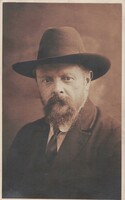 Prof. John Howley John Francis Whittington Howley (1866 – 1941) was Professor of Philosophy in UCG from 1914 to 1936. He received the D.Litt. in 1924 and was the Librarian in UCG from 1917 until his retirement in 1936. He died in August 1941. John Howley was educated at Summerhill College, Sligo; St. Stanislaus’s College, Tullabeg; and at University College Dublin. He received the BA degree in 1888, majoring in Philosophy, and Physics and Chemistry. He received the MA degree in Philosophy in 1889 and the D.Litt. in 1925 for his book, Psychology and Mystical Experience. He was appointed Professor of Psychology and Pedagogy at St. Patrick’s Training College, Drumcondra, Dublin in 1908 and he became Professor of Philosophy at UCG in 1914. He was Librarian from 1917 until his retirement in 1936. He was a member of the Governing body in 1928. He made many contributions to periodicals and was in great demand as a reviewer. He was an impressive public speaker. Howley, who was unmarried, lived at 11 The Cresent, Galway and on his retirement moved to ‘Cepeda’, Goatstown Road, Dundrum, Co. Dublin. John Howley died on 29 August 1941 in Monkstown Hospital, with a given age of 76 years, and his funeral was attended by An Taoiseach, Éamon de Valera; the Minister of Education; and the Lord Mayor of Dublin (J. Howley, 1941, pp 601-04). Further details of his career are given in 'T. Foley & F. Bateman, 1999, pp 415-17'.
-
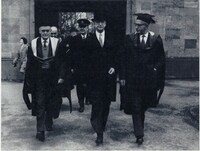 President de Valera, Prof. Thomas J. Dinan and Prof. James Mitchell The picture shows the President, Eamon de Valera, Chancellor of the National University of Ireland (NUI) alongside Prof. Thomas J. Dinan (Acting President of UCG) left of picture and Prof. James Mitchell, Registrar and Secretary of UCG. The second row shows Séamus Wilmot, NUI Registrar (to the left) and Colonel Sean Brennan, Aide-de-Camp to the President. The Chancellor of the NUI had come to UCG to confer Degrees and Diplomas on the 5th of September 1959. Thomas John Dinan, MSc was appointed Professor of Natural History in 1927. He married Mary Josephine (Nina) Carlos on 17 Dec. 1942 in St. Andrew’s Church, Dublin. Her bridesmaid was Bridget Byrne (likely Ciss Byrne). Thomas Dinan was Acting President of UCG following Rt. Revd Monsignor de Brún’s retirement in 1959. Thomas Dinan retired in 1960.
-
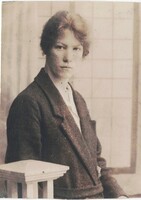 Peggy McDermott, Summer 1921 Margaret (Peggy) McDermott was born in August 1900. She entered UCG in 1918. She obtained her B.A. degree in 1922 with 1st Class Honours and the Higher Diploma in Education also with 1st Class Honours in 1929 (Special Collections). Margaret (Peggy) McDermott was born on 15 August 1900 (www.irishgenealogy) to parents Patrick McDermott, farmer, Two Mile Ditch, Castlegar, Galway City and Kate Jennings. She came to UCG in 1918 as is also shown in the 1918 – 19 List of Students. The First Examination in Arts in Summer 1919 shows Margaret obtaining 1st Class Honours in Irish and in Logic; and 1st Class Honours in Irish & French in the Autumn Examination of 1921. She obtained her BA degree in 1922 with 1st Class Honours and obtained the Higher Diploma in Education also with 1st Class Honours in 1929.
-
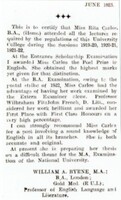 Attestation for an outstanding student, 1923 William A. Byrne, M.A., Professor of English Language and Literature in UCG (1917-1933) wrote an attestation for Rita Carlos in June 1923 for (a) her attendance at all lectures required by the University over the three year period from 1919 to 1922; (b) for receipt of the highest marks yet given in her award of the Peel Prize in English Composition in 1919; and (c) in obtaining 1st place and the highest marks for the B.A. Examination in 1922 (Special Collections). Two prizes, originally founded by Sir Robert Peel, with value of about £5 in the 1923 – 24 period, were offered each year for competition among candidates who are matriculated students of the National University of Ireland – one offered in English Composition and the other in Geometry. Rita Carlos was awarded the Peel Prize in English Composition in the Michaelmas Term of 1919. She obtained the highest marks yet given in the words of William A. Byrne, M.A., Professor of English Language and Literature in UCG. Her sister Nina Carlos was awarded the Peel Prize also in English Composition in the following year of 1920.
-
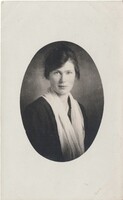 Martina Loughney Portrait, 1921 Martina Mary Loughney was born in Killala, Co. Mayo on 17 Dec 1901 (www.irishgenealogy.ie) to parents Martin Loughney and Ellen Timlin. She was awarded a Mayo County Council Scholarship in 1920 and went to UCG as also confirmed through being on the 1920 – 1921 List of UCG students. She obtained a 1st Class Honours B.A. degree and a B. Comm. degree in 1923.
-
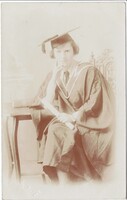 Margaret (Peggy) Burke Graduation, 1921 Margaret Mary Josephine (M.J.) was born on 20 March 1901 in Shrananagh, Co. Sligo. She won a Sligo County Council Scholarship and went to UCG in 1918. She obtained a 1st Class Honours B.A. degree in 1921 and obtained a H. Dip. In Education in 1922 (Calendars, Archives & Special Collections). Margaret (Peggy) Mary Josephine (M.J.) Burke was born on 20 March 1901 (www.irishgenealogy) in Shrananagh, Co. Sligo to parents Martin (a school teacher) and Bridget Beirne. She won a Sligo County Council Scholarship in 1918 and came to UCG, as shown on the Student List for 1918 – 1919. She obtained 1st Class Honours in Irish and French and 2nd Class Honours in English & Logic in 1st Arts in the Summer of 1919. She obtained a pass in English as a subsidiary subject in summer 1920 for the Honours B.A. Degree. She was jointly awarded the ‘Dr. And Mrs. W.A. Browne’ Scholarship in the 1920 – 21 Session. She obtained 1st Class Honours in her B.A. Degree in 1921 and was awarded a Post-Graduate Scholarship in the Faculty of Arts. She obtained the Higher Diploma in Education in the summer of 1922.
-
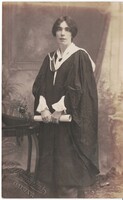 Frances Moffett Graduation Portrait Frances Moffett was born in Dunlo Street, Ballinasloe. Co. Galway on 4 Oct 1900. The family moved to Gentian Hill, Galway on 18 Dec 1908. She went to UCG in September 1919 and she graduated in September 1922 with a 1st Class Honours BA Degree, followed by a Higher Diploma in Education with 2nd Class Honours in 1923 (UCG Calendars). She left Ireland in 1924, never to return there to live. She joined the teaching profession in England until about 1936, and then trained for full-time work in the Church of England, later becoming Vice-Principal of a Women’s Theological College (Wikipedia, Frances Moffett, Jan., 2024). Frances Moffett, daughter of Arthur Moffett, veterinary surgeon, and Jane Dods was the eldest of five children of a Presbyterian family. She attended the H School in Galway under Presbyterian management, but after a year was placed in the Model School, built for the training of Protestant pupil teachers. She went to UCG in September 1919 taking as her subjects - Experimental Physics, Mathematics and English for the BA. She joined the teaching profession in England, later becoming Vice-Principal of a Women’s Theological College. Retiring from Church work in 1960, she returned to teaching in schools and in a College of Education. In 1985, she published a memoir ‘I also am of Ireland’ of the first 24 years of her life. Frances Moffett passed away in 1992 (www.freebmd.org.uk) in the District of Merton, Greater London (B. Lally, Ballinasloe Life, Feb 2021, pp 59-60).
-
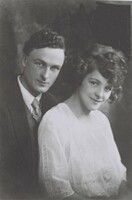 Delia Murphy and Thomas Joseph Kiernan Delia Murphy was born on 16 February 1902 at Ardoe, Claremorris, Co. Mayo. Delia was educated at the local primary school, then at the Dominican Convent, Eccles St., Dublin, where she was taught singing by Mother Clement Burke. She went to UCG in 1920 and graduated with a B.Comm. degree in 1923 (Special Collections). While studying for her degree, she sang at student and minor concerts. She married Thomas Joseph (T.J. / Tommy) Kiernan, civil servant, on 24 February 1924. She died in St Kevin's Hospital, Dublin, on 12 February 1971 (civilrecords.irishgenealogy.ie). Delia Murphy was the second of eight daughters of John Murphy and Anna Agnes Fanning. She dated her introduction to traditional Irish ballads from her primary school days to the ballads she learned from Tom Maughan, a local itinerant boy who taught her to sing ‘If I were a blackbird’. Shortly after their marriage, T.J. Kiernan was appointed secretary to the Irish High Commission in London, and during their time there, their four children were born: Blon, Naula, Colm, and Orla. In 1935 the family returned to Dublin where T.J. Kiernan took up the post of Director of Broadcasting at Radio Éireann, which he held on secondment until 1939. During these years, Delia's singing career reached its heights, when she recorded almost 100 songs with HMV. From this time until the mid-1950s, she was the most important exponent of Irish ballad singing to reach an audience on an international scale. She broadcast numerous times from Radio Éireann, becoming a household name. She wrote many of the songs herself and attributed much of her inspiration to itinerants' songs. Songs she made famous included ‘The spinning wheel’, ‘I'm a rambler, I'm a gambler’, and ‘Three lovely lassies from Bannion’, (Wikipedia/Delia Murphy). She accompanied her husband on all his postings (Dictionary of Irish Biography), (doi.org/10.3318/dib). In 1941, T.J. Kiernan was appointed Irish Minister to the Vatican. In 1946 the Holy See made her a Dame of the Holy Sepulchre. 1946 saw the Kiernans posted to Canberra, Australia; 1952, Bonn, West Germany; 1957, Ottawa, Canada; 1961, Washington, DC, USA. Delia did not spend a lot of time in Washington, and lived on the family farm in Ottawa. It was while they were in Washington that Delia recorded her last record, The Queen of Connemara, the only LP she made. When her husband died (December 1967), Delia stayed in Ottawa and it was there that she gave her last concert at Camp Fortune in the Gatineau Hills. In November 1969 she sold the farm and returned to Dublin, where she purchased Liscannor Cottage, Chapelizod. She died in St Kevin's Hospital, Dublin, on 12 February 1971.
-
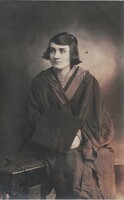 Ciss Byrne Graduation Brigid Mary (Ciss) Byrne, daughter of Patrick Byrne and Cecily Morris was born in Vicar Street, Tuam on 19 Aug 1900. She went to Loreta, Stephen’s Green, Dublin. From there she went to University College Galway in 1918, with her name appearing in the list of students for the academic year 1918 – 19. She graduated in 1921 with a 1st class B. Comm. Degree and she obtained a B.A. degree with 2nd class honours in French and Irish in the autumn of 1922 (UCG calendars). She became friendly with the Carlos sisters at the University. After qualification she got a job at the Galway VEC, known as ‘The Tech’. It was then divided into a Boys and Girls section and Ciss was the Girl’s Headmistress up to her retirement. She passed away on 1 January 1993, aged ninety two years of age. She is buried in the Byrne Family Grave in Tuam Cemetery.