-
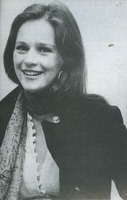 Miss College Week 1974 Winner
UCG student Sue Toner was the winner of the Miss College Week Competition 1974. This image appeared on the front cover of UNITY Magazine, a college publication produced by the UCG Students Union. The image was on the front cover of the magazine dated 14 March 1974.
-
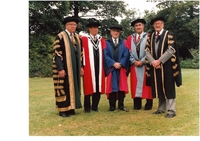 John McGahern, DLitt, Patrick D. (Paddy) Ryan, LLD, and
Patrick J. Leonard, DSc honorary conferrings, 1994
Image taken following the conferring in Galway of honorary degrees by the NUI, on the proposal of UCG, on John McGahern (DLitt), Patrick D. (Paddy) Ryan (LLD) and Patrick J. Leonard (DSc) in 1994. Image also includes Dr T.K. Whitaker (Chancellor of the NUI) and Dr Colm Ó hEocha (President of UCG).
-
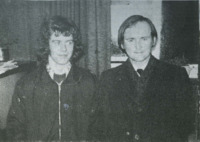 Eamon Gilmore and Harry Walsh President of UCG Students Union election 1974
The victor of the 1974 election for President of UCG Students Union, Eamon Gilmore, is pictured with his opponent in the election, Harry Walsh. The election took place on 12th March 1974. 1,395 students voted in the election and Mr. Gilmore received 1,152 votes, representing 82% of the votes cast.
-
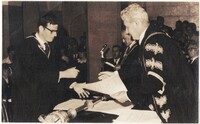 Patrick Larkin Graduation, 1966
The photograph shows Patrick Larkin receiving the B.Sc. degree from Dr Martin Newell, President of UCG. Prof. Cilian Ó Brolcháin to the right of President Newell, was acting in his capacity as Dean of the Faculty of Science.
Martin J. Newell, was Professor of Mathematics in University College Galway (1955 -1960) and he was appointed President of University College Galway in 1960 and he retired from the post in 1975.
Cilian Ó Bhrolcháin, was appointed Professor of Experimental Physics in 1934 and he resigned from the post in 1973 (Tom O’Connor, 'Natural Philosophy / Physics’).
-
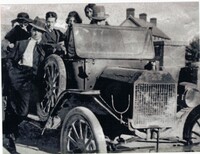 Motor vehicle on Beggars Bridge, 1921
The picture shows (l to r) the following persons: Charlotte Carlos; vehicle driver; Patt Larkin; Rita Carlos; Nina Carlos; and Charles Carlos in / alongside a Model T Ford motorcar. The vehicle was located on Beggars Bridge (as written on the back of the photograph) at the UCG Rowing club. The Model T Ford motorcar was complete with removable acetylene lamps and was hired from Flaherty Motors.
Charlotte Shortle Carlos and Charles Carlos were the parents of Margaret (Rita), and Mary Josephine (Nina).
Rita married Patt Larkin, Prof. of Education, UCG and Nina married Tom Dinan, Prof. of Natural History, UCG.
-
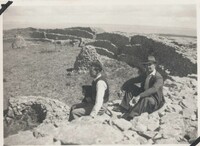 Inishmaan stone fort, 1948
The photograph shows Patt Larkin, Prof. of Education, UCG (on the left of picture) with Mr. McGinley, a kelp inspector, on Dún Conor (Dún Chonchúir) on Inishmaan, Aran Islands. Dún Conor (Wikipedia_Conor, 2023) is a stone ringfort with partly rebuilt (by the OPW (Office of Public Works) ‘clocháns’ or stone houses. The three-stage, dry-built rampart is probably pre-Christian in foundation.
The kelp industry was important to the subsistence economy in the Aran Islands. Images of large piles of seaweed drying, prior to its burning for the iodine industry, are shown in the Chambers Archive, held by Galway County Council (Galway County Council Archives, 1929-1938); (J. Higgins,1931, pp 59 – 72). The seaweed was collected from rocks after the storms of autumn and winter, dried on fine days, and then made up into a rick, where it was left until the beginning of June. It is then burnt in low kilns on the shore, a process that takes from twelve to twenty-four hours of continuous hard work. The kiln holds about two tons of molten kelp, and when full it is loosely covered with stones and left to cool. In a few days the substance is as hard as the limestone and has to be broken with crowbars before it can be placed in curraghs for transport to Kilronan, where it is tested to determine the amount of iodine it contains and paid for accordingly. In former years good kelp would bring seven pounds a ton, now four pounds are not always reached (J. Higgins,1931, pp 59 – 72). The income gleaned from its collection, burning, sale and transport was significant for the Islanders (D. Fitzpatrick, 2012). In former years, good kelp would bring seven pounds a ton, now four pounds are not always reached (J. M. Synge,1907, pp 194-5).
-
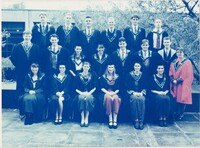 Biotechnology Graduate Class of 1995
The B.Sc. in Biotechnology was planned from 1988 by a group convened by Prof. Denis Headon of the Biochemistry Department, with major input from Prof. Frank Gannon of the Microbiology Department. The first intake was in Sept. 1991. Dr Pat Morgan was appointed as Lecturer for this programme in Jan. 1992 and she assumed the role of Director in 1996.
A picture of the Biotechnology Graduation Class of 1995 is shown and class names are given from left to right below:
Top Row: Michael Considine; Christian Stafford; Eric Mortimer; John Lennon; Daniel McKenna; Turlough Rafftery
Middle Row: Padraig Kelliher; David Ryan; Bridget Jennings; Caren Coonan; Liam Duggan; Barry Glynn; Nigel Mongan; Dr Pat Morgan
Front Row: Elaine O’Doherty; Lassarina McLoughlin; Louise Kelly; Angela Stakelum; Michele O’Rourke; Aideen O’Doherty
The first intake of students for the new Biotechnology course took place in Sept. 1991 and attracted students from the counties of Clare, Galway, Laois, Leitrim, Longford, Mayo, Tipperary, Westmeath and Kerry.
The Biotechnology curriculum was novel at the time as it included Business modules as well as French or German and a research or industrial placement in the Summer of year 3. The knowledge of languages was a tremendous asset for students undertaking their 3rd year placements in Europe or later for their PhD o postgraduate research. The calibre of the students was outstanding and such was the reputation garnered over the years that B.Sc. graduates were sought after for research degrees in Cambridge, Oxford, European Molecular Biology Laboratory, Heidelberg. This first class, and many that followed, had a great esprit de corps and have maintained contact with each other and the University through various reunions.
Dr Pat Morgan was elected as Dean of the College of Science for the period 1998-2004 and was the first woman to hold the post since the establishment of the University. She was elected by academic staff to the Governing Authority of the University on six occasions, from 1998-2018 and to the Senate of the National University of Ireland from 2002-2022. She was appointed as the first Dean of Graduate Studies in 2008 and served in the post until her appointment as Vice-President for the Student Experience in 2011. She retired in 2018 and her portrait by Una Sealy RHA, hangs in Áras na Mac Léinn
-
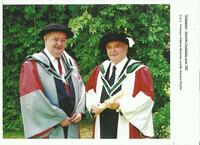 Heinrich Pfeiffer, DLitt honoris causa, 1993
On the right, Heinrich Pfeiffer, Secretary-General of the Alexander Humboldt Foundation (1956-94) following conferral on him by the NUI, on the proposal of UCG, of the honorary degree of DLitt in UCG in June 1993, with Professor Matthew F. McCarthy, Registrar and Deputy-President, UCG, who delivered the citation.
-
Brian J. Donnelly, LLD honoris causa, 1993
Brian J. Donnelly, of Boston, Mass., USA former member of the US Congress (1979-93) being congratulated by An tOllamh Gearóid Ó Tuathaigh, who had delivered the citation, following the conferral by the NUI, on the proposal of UCG, of the honorary degree of LLD on him in UCG in June 1993. The photograph was taken behind the southwest corner of the Quadrangle.
Brian Donnelly was largely responsible for the enactment of the so-called 'Donnelly Visa' programme, which authorised 5,000 visas annually for citizens of countries historically under-represented in the United States' immigration system, and whose primary beneficiaries were, as was intended, Irish nationals.
-
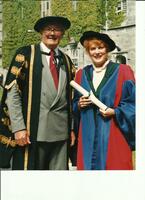 Maureen O'Hara Blair, DLitt honoris causa, 1988
Maureen O'Hara Blair with Dr Colm Ó hEocha, President of UCG, following conferral by the NUI, on the proposal of UCG, of the honorary degree of DLitt on her in UCG on June 26, 1988. The citation was given by Dr Ó hEocha, who here is wearing the robe appropriate to his office as one of the three Pro-Vice-Chancellors of the NUI.
In an interview on that occasion with Jim Fahy of RTÉ, Maureen said, 'This particular honour here - I have won many, many awards all over the world, I have been honoured in Spain, in Mexico, in Australia, in Cuba, but never in Ireland, and so it's really a great, great thrill to be honoured by this country that I was born in, and particularly by Galway, where we made The Quiet Man'. The photograph was taken in the Quadrangle.
-
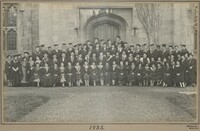 UCG Graduates group photo 1935
This is a graduation photo taken on the steps of the entrance to the Aula Maxima, in the Quadrangle of University College Galway. The handwritten date on the photograph indicates that this was the graduation class of 1935, which according to the UCG College Calendars comprised of B.A., B.Comm. B.Sc. MA and H.Dip.Ed. graduates.
-
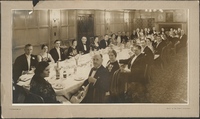 Galway Graduates' Association Manchester 1936
-
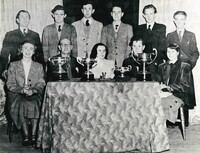 Group of students with Professor Diarmuid Murphy and Christy Townley
This appears to be a group of students accompanied by two college staff - Christy Townley (standing at back, extreme left) and Professor Diarmuid Murphy, professor of English, seated second from left). The table laden with trophies appears to indicate that this was the UCG Drama Group which was successful in winning a number of trophies for their theatrical productions. An Cumann Drámaíochta, the college based Irish language drama group, was also very successful in staging Irish language productions.
-
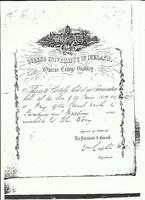 QCG Certificate of award of Engineering prize, 1859-60
A Certificate of the award by Queen's College, Galway of a Prize of the second rank in Surveying and Mapping to an Engineering student, Mr John Berry, at the close of the 1859-60 Session. The Certificate, which was signed by William Lupton, MA (Registrar, 1853-70, and later Professor of Jurisprudence and Political Economy , 1870-76) is emblazoned with the the heading, 'QUEENS UNIVERSITY IN IRELAND' and underneath it 'Queens College Galway'. (In the case of both those titles, the use of the old English non-apostrophe tradition in the case of such possessives may be noted. In the case of the College's title, the lack of a comma after 'College' may also be noted. In fact, whereas in later Calendars and Reports the College is consistently referred to as 'Queen's College, Galway' (i.e. with the comma after 'College'), the actual legal title as stated in the Charter is ‘Queens College Galway’ (i.e. without the comma after 'College').
This and other such copies of Certificates, provided to the University over the years by descendants of past students in their quest for information on them, are of particular interest, as no copies of such Certificates were retained in the University archives. They are also of interest in terms of design: here, for example, the depiction of the Quadrangle, with bushes or trees in front on either side, and further in front the College Arms resting tilted on, it would seem, a bed of shamrocks, but with the scroll and motto DEO FAVENTE shown beneath, rather than above, the Arms.
College records show that John Berry entered the College in the 1858-9 Session, aged 17, in the School of Engineering. His father was Thomas Berry, his religion Protestant, and his address Durrow, Queen's County (i.e. Laois). His school was Hawthorn Hall, Manchester. According to further similar Certificates copied to us by Gordon Berry (see below), he completed the Second Engineering course in the Session 1860-61 and was awarded 'a Prize of the second rank in Engineering' at the close of that Session. There is no further record of him, and he does not appear among the graduates of the College, of the Queen's University in Ireland, or of the Royal University of Ireland (which replaced the Queen's University in 1882). A note from Gordon Berry records his date of birth as May 25, 1841 at Tullamore, King's County (i.e. Offaly).
-
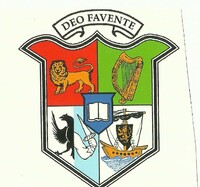 Arms of QCG, UCG, NUI Galway and University of Galway / Ollscoil na Gaillimhe
These are the arms of Queen's College, Galway, University College, Galway (Coláiste na hOllscoile, Gaillimh), National University of Ireland, Galway (Ollscoil na hÉireann, Gaillimh), and the University of Galway (Ollscoil na Gaillimhe). The Arms, dating from the earliest days of Queen's College, Galway, comprise a blue inescutcheon or shield divided into quarters, describing, in increasingly specific terms, the location and purpose of the College. The first quarter, against a red background, a golden lion walking towards the left with full face towards the spectator, represents England; the second quarter, against a green background, a golden Irish harp with silver strings, represents Ireland; the third quarter shows the arms of the province of Connacht - specifically, in the left half, against a silver/white background, a black eagle, halved, with wings expanded, and in the right half, against a blue background, a bent arm holding a dagger erect (natural colouring); and the fourth quarter shows the arms of the town of Galway, viz. against a silver/white background, a golden galley, riding on the waves of the sea (natural colouring), with one mast and sail furled, the rigging bearing a black shield on which a golden lion appears in profile, standing on the left hindleg, the right hindleg raised above it and the forelegs elevated. The open blank book superimposed on the centre point is a standard heraldic symbol for an institution dedicated to learning. The motto on the scroll surmounting the arms, in Latin, is ‘Deo Favente’ (‘With God’s Favour’).
The technical heraldic description is as follows:
Quarterly.
1. Gules a lion passant gardant (Or)
2. Vert a harp Or stringed Argent
3. Per Pale. Dexter: (Argent) an eagle displayed (Sable) dimidiated. Sinister: Azure an arm embowed issuant from the dexter flank and holding a dagger erect (proper)
4. Argent, on waves of the sea in base proper a galley Or with one mast and sail furled, the rigging charged with an escutcheon sable, thereon a lion rampant of the third Or.
There has, however, never been an official grant of those Arms, or any other Arms, to the College or University. The Board of Presidents and Vice-Presidents of the three Queen's Colleges (Belfast, Cork and Galway), set up to make recommendations to the Lord Lieutenant as to Statutes, programmes and structure for the newly established Colleges, suggested to the Lord Lieutenant (through the Under Secretary) on January 16, 1846 that Ulster King of Arms be asked to assign Arms to each College - this on the grounds that their Charters required them to use a Common Seal and that 'possession of a seal implies a device and arms thereon'. He declined, because of the unnecessary expense involved, and he suggested instead that 'their own taste may enable them to devise a suitable seal for each College, with the date of the foundation of the College and an appropriate motto either in Latin or English'. The Lord Lieutenant's own reaction to the request, as reflected in his note in the margin of the record, was rather more heated: 'I cannot see the slightest necessity for asking for the acceptance of the Ulster King of Arms in either case* - any engraver would furnish a Sketch for a Seal bearing the name of the College and the date of the Foundation – it might be either in Latin or English'.
(*The Board had suggested that the devising of an appropriate costume or robe for students and those in higher offices be also referred to Ulster King of Arms.)
There appears to be no further evidence as to the selection of the specific 'Deo Favente' motto in our case, but it would then presumably, in the light of that direction from the Lord Lieutenant, have been decided by the Council of the College itself, comprising the President, the Vice-President and the four Deans of Faculty, or perhaps by the President, Rev. Joseph Kirwan, himself.
These Arms were retained by the Governing Body when University College, Galway / Coláiste na hOllscoile, Gaillimh was established in 1908. The question of College Arms, intertwined with the rather more urgent issue of a College Seal, was discussed at several meetings of the Governing Body and its Standing Committee in 1909 and 1910. The Standing Committee (21/10/1910) 'decided to recommend the Governing Body to adopt the old arms of the College and have them confirmed and to appoint Prof. Trench and Dr. Henry to procure designs for a College Seal with a legend in Latin and Irish'. This recommendation was referred back to the Committee, and at its meeting on 2/3/1911 'it was decided to adopt an Armorial Seal with the legend "The Common Seal of University College Galway"', and it 'ordered that £10 (a sum not exceeding) be expended on Engraving'. At its meeting on 16/3/1911, 'it was ordered that the engraving be put in hand at once - the arms to be those of Queen's College'. On 16/5/1911, noting that a Common Seal had been procured in accordance with those directions of Standing Committee, the Governing Body formally adopted the Seal, though only by the casting vote of the President, following a proposal from Dr Mac Enrí that the words "until the Governing Body adopt another" be added. The dissent probably related to the legend's being only in English, rather than in Latin and Irish as recommended earlier by Standing Committee, as Dr Seán Mac Enrí proposed a motion (wording not reported) regarding the College Seal to the Governing Body meeting of 20/2/1912; it was referred to Standing Committee and eventually, with no report on it yet from the Committee, withdrawn by him almost a year later.
Progress on the question of the formal acquisition of College Arms was rather more protracted. Finance Committee (30/4/1915) reported as follows: 'A communication from the Office of Arms dealing with the Arms of the College was considered. The Committee considered that the College could not afford to pay £44 for a grant of Arms'. Matters rested thus till Standing Committee (19/1/1940) 'decided that the advisability of procuring the 'College Arms' be considered at its next meeting', and on 29/1/1941 'recommended to the Governing Body that the College Arms be obtained - cost £44'. Economic reality, however, soon intervened as it had previously: at its meeting on 26/2/1941, 'As a result of the discussion of the Estimates when the increasing yearly expenditure was stressed, the Committee decided to rescind its recommendation re the College Arms'.
-
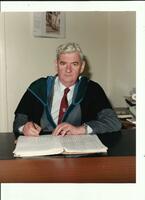 Séamus Ó Cathail, Rúnaí Acadúil / Academic Secretary
Séamus Ó Cathail (1925-91), Rúnaí Acadúil (Academic Secretary) of UCG (1969-91), in his MA academic robe and wearing the maroon UCG tie with the College Crest, writing at his desk in his office (Room A131 in the Quadrangle, previously the Staff Room). He was the first professional academic administrator in the Irish University system, assuming the student registration, academic administration and other related responsibilities theretofore assigned to the Registrar, together with the examination responsibilities held by the NUI-appointed Supervisor of Examinations (though that office continued to be held till a vacancy therein in 1973). He was also Secretary to the Academic Council. As the Charter of the College required that there be a Registrar, new responsibilities relating mainly to new academic staff, academic staffing and resources, and student welfare were assigned by Statute to the Registrar (a Professor elected for a three-year term, subject to a maximum of two terms), who also ranked second only to the President.
Séamus Ó Cathail had previously been Secretary to the Commission on the Accommodation Needs of the NUI Constituent Universities (1958-59) and then Secretary to the Commission on Higher Education (1960-67), chaired by Cearbhall Ó Dálaigh and which set the strategic and structural parameters on the policy for development of the Irish Higher Education sector for decades ahead. He was Cathaoirleach of the Central Applications Office (1978-91) and for several years was the representative of the Irish Universities on the Liaison Committee of the Rectors' Conferences of EC Universities.
-
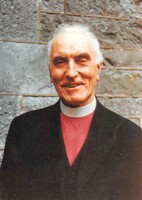 Monsignor Pádraig de Brún, President of UCG, 1959
Monsignor Pádraig de Brún was President of UCG from 1945 to 1959, succeeding Monsignor John Hynes.
-
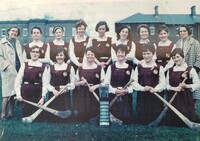 UCG Camogie Team with Professor Elizabeth (Nellie) Lee
This is the 1968 Ashbourne Cup winning camogie team from UCG. There are 134 members of the team depicted, and they are accompanied by, on the left, Prof. Elizabeth (Nellie) Lee of the Chemistry Department, who mentored the team, and on the right of the photo Mrs. Mary O'Driscoll, the Lady Superintendent who normally accompanied the team to all matches. As of 2023 the Ashbourne Cup has been won by the UCG Camogie team on 15 occasions, the last in 1994.
-
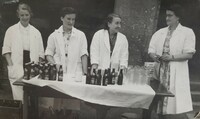 Catering Staff in Quadrangle
This group of four women comprised the catering staff of the university coffee shop. The coffee shop was located in a former sports pavilion on campus, and from its establishment in 1952/53 was the only place on campus where refreshments could be purchased. The coffee shop staff occasionally catered for other events on campus, and this image appears to depict an outdoors event taking place in the college Quadrangle. It may have been to celebrate a sporting event or it may have been one of the annual end of academic year parties which were held for academic staff in the Quadrangle, the exact nature of the event is unclear. Pictured on the extreme right is Mrs. Creaven, affectionately known to generations of students as 'Ma Creaven' who managed the coffee shop with her team from its opening until her retirement in 1975. Apart from Mrs. Creaven the other women in the photo are unidentified.
-
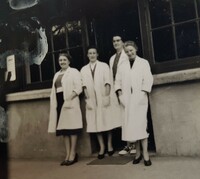 Catering Staff Coffee Shop
This is a group of four women who comprised the catering staff of the university coffee shop. The coffee shop was located in a former sports pavilion on campus, and from its establishment in 1952/53 was the only place on campus where refreshments could be purchased. Second from right, at rear, is Mrs. Creaven, affectionately known to generations of students as 'Ma Creaven' managed the coffee shop with her team from its opening until her retirement in 1975. On her retirement the running of the coffee shop was taken over by Peggy Jordan, and it became known as 'Peggy's'. Apart from Mrs. Creaven the other women in the photo are unidentified.
-
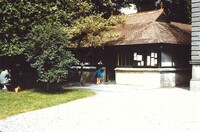 Coffee Shop
The university coffee shop, presided over by Mrs. Creaven (known affectionately to all as 'Ma Creaven') was for many years the only place available on campus to purchase refreshments. A former sports pavilion, it was the social hub of the college and notices for all sporting and social events were displayed in its windows or on its interior walls. It appears to be Spring or early Summer, as the sun is shining, an unidentified woman wearing white sunglasses is pictured about to enter the building, and under an adjacent tree a group of unidentified students are seated at a picnic table.
-
Coffee shop
-
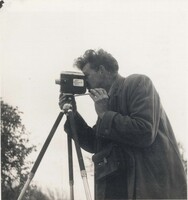 Taking a picture in Aran, 1954
Patt Larkin, Professor of Education, visiting the Aran Islands in 1954 as a member of the Education Film Unit (Aonáid Scannáin, Ollscoile na Gaillimhe). The picture shows Patt Larkin taking a picture with a camera mounted on a tripod. It was an 8mm movie camera.
-
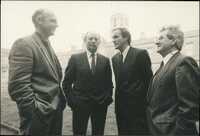 John McGahern with Kevin Barry, Tom Boylan and Gearóid Ó Tuathaigh
-
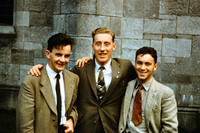 Tom O’Connor and friends, 1959
Seen here from left to right: Unidentified; Tom O'Connor; Frank Imbusch.
Tom O'Connor was at the time a lecturer in the Physics Department.
After his studies in UCG, Frank Imbusch departed for the US where he gained his PhD (Stanford) and then worked as a researcher for several years for Bell Laboratories, New Jersey. He was to return to Galway in 1967 to take up an appointment as a lecturer in the Physics Department.
