-
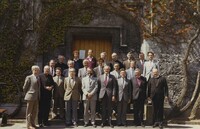 Governing Body of UCG, 1983-86 / Coiste Rialaithe Choláiste na hOllscoile, 1983-86
An official photograph, taken in June 1983, of the members of the Governing Body of UCG in office for the period 1 February 1983 - 31 January 1986, together with the two senior members of administrative staff who serviced it. Missing from the photograph are M.P.J. ('Bobby') Curran (elected by the Graduates), Eugene Henry (elected by Sligo Co. Council), Professor Seán M. Lavelle (elected by Academic Council), Seán McEvoy (elected by Mayo Co. Council) and Pascal McKeon (elected by Leitrim Co. Council).
-
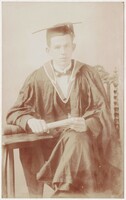 Patt Larkin Graduation Portrait, 1922
Patrick (Patt) Larkin attended UCG, obtaining a BA degree in 1922. He was appointed Professor of Education in 1925 and was Bursar of the College from 1946 to 1965. He retired in 1967. He was married to Margaret (Rita) Carlos and they had nine children. He died on his 98th birthday, 29th September 1998.
-
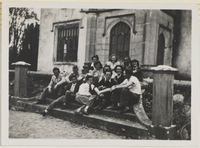 A cycling outing, c. 1947
For undergraduates in Galway, cycling expeditions were a popular activity in this period. Among those present in this photo is Una O'Cleary (2nd row, last on right), who graduated with a Bachelor of Arts degree in 1950.
-
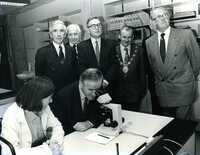 Opening of the Clinical Science Institute, 1992
The Clinical Science Institute is located on the grounds of University College Hospital, Galway. The Hospital, being designated as a 'teaching institution', the local authority was required to provide research facilities. The resulting institute was officially opened by the then Taoiseach, Mr Albert Reynolds in 1992.
Pictured here, from left to right, are:
Standing: John Flynn; Unidentified; Charles Eugene (Gene) Connolly; Henry O'Connor; Colm Ó hEocha.
Seated: Unidentified medical student; An Taoiseach Albert Reynolds
-
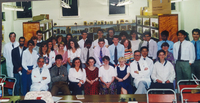 Old Pathology Museum, NUI Galway
Among those pictured in the front row are Professors John Flynn (1st from l.) and Eugene ('Gene') Connolly (2nd from r.).
The old Pathology Museum housed a medical collection of specimens used for familiarizing students with a range of pathological conditions. It was closed when the display of human body parts became controversial.
The origin of the museum dates back to the early decades of the Queen's College Galway. In 1859 the University acquired the Montgomery Collection 'containing over 600 specimens relating to the pathology, anatomy and physiology of the reproduction system' ('A History of the College of Medicine'). It followed the creation, in 1851, of a museum for natural history and geology.
Known as the Museum of Human and Comparative Anatomy, the early collection was organised by the Foundation Professor of Anatomy and Physiology, Professor Charles Croker King (Murray, 1999). In addition to this, the Medical Museum contained a Pathology section.
In 1914 the Pathology Department was relocated to the top of the Engineering Building, just north of the tennis courts. It comprised a students' laboratory, a research laboratory and the museum with its growing collection of specimens.
These and other museums in the Queen's Colleges played a central role in science education in the 19th century, for the benefit of both students and the 'inquiring public'. In the early days they 'also demonstrated to visitors that intellectual culture had arrived in provincial Ireland' (Adelman, p. 4).
-
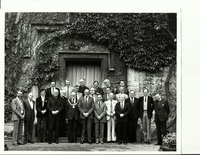 Governing Body of UCG, 1980-83/ Coiste Rialaithe Choláiste na hOllscoile, 1980-83
<p>An official photograph of the members of the Governing Body / Coiste Rialaithe in office for the period 1 February 1980 – 31 January 1983, together with the two senior administrative officers servicing it. Missing are 3 members, viz. <a href="https://en.wikipedia.org/wiki/Mich%C3%A9al_%C3%93_hUiginn" target="_blank" rel="noreferrer noopener">Mícheál Ó hUiginn</a> (representing Galway Corporation ?), and two others.<br />
Pictured, from left to right: <br />
<em>Third row</em>: Seán McEvoy (Mayo Co. Council), Professor <a href="https://en.wikipedia.org/wiki/Martin_L._Newell" target="_blank" rel="noreferrer noopener">Martin L. Newell</a> (graduates’ nominee), Most Rev. <a href="https://en.wikipedia.org/wiki/Michael_Harty_(bishop)" target="_blank" rel="noreferrer noopener">Michael Harty</a> (Bishop of Killaloe; Clare Co. Council nominee). <a href="https://prabook.com/web/michael_patrick_bobby.curran/361046" target="_blank" rel="noreferrer noopener">Michael P. J. (‘Bobby’) Curran</a> (graduates’ nominee), Séamus Ó Cathail (Rúnaí Acadúil / Academic Secretary), Dioraí Ó Coirbhin (Rúnaí-Sparánaí / Secretary-Bursar).<br />
<em>Second row</em>: An tOllamh <a href="https://www.ainm.ie/Bio.aspx?ID=1722" target="_blank" rel="noreferrer noopener">Eustás Ó Héideáin,</a> Dr <a href="https://issuu.com/ballymoteheritagegroup/docs/the-corran-herald-issue-54-2021-2022/s/16699626" target="_blank" rel="noreferrer noopener">Hubert McDermott </a>(coopted), Professor <a href="https://www.maths.tcd.ie/pub/ims/bull69/Flavin.pdf" target="_blank" rel="noreferrer noopener">James N. Flavin</a> (Academic Council nominee), <a href="https://www.ainm.ie/Bio.aspx?ID=1848&AspxAutoDetectCookieSupport=1" target="_blank" rel="noreferrer noopener">Cathal Mac Gabhann</a> (Príomhfheidhmeannach Údarás na Gaeltachta; NUI Senate nominee), <a href="http://www.jstor.org/stable/2072016" target="_blank" rel="noreferrer noopener">Christopher J. Townley</a> (Librarian; elected by graduates).<br />
<em>Front row</em>: An tOllamh Déaglán Ó Caoimh (J.D. O’Keeffe) (Registrar, elected by Academic Council), Patrick Briody (Leitrim Co. Council), Séamus Scott (Roscommon Co. Council), Most Rev. <a href="https://en.wikipedia.org/wiki/Joseph_Cunnane" target="_blank" rel="noreferrer noopener">Joseph Cunnane</a> (Archbishop of Tuam; nominee of Minister of Education), Eugene Henry (Sligo Co. Council), An Dr <a href="https://en.wikipedia.org/wiki/Colm_%C3%93_hEocha" target="_blank" rel="noreferrer noopener">Colm Ó hEocha</a> (Uachtarán), Professor <a href="https://exhibitions.library.universityofgalway.ie/admin/item/13717" target="_blank" rel="noreferrer noopener">George F. Imbusch</a> (elected by Academic Council), Professor <a href="https://www.dib.ie/biography/dunican-laurence-kieran-l-kieran-a2842" target="_blank" rel="noreferrer noopener">L. Kieran Dunican</a> (elected by Academic Council), <a href="https://president.ie/en/the-president/michael-d-higgins" target="_blank" rel="noreferrer noopener">Michael D. Higgins</a> (Galway Co. Council), Professor <a href="https://www.symposiummaternalhealth.com/speaker/eamon-odwyer/" target="_blank" rel="noreferrer noopener">Eamonn O’Dwyer</a> (coopted), An Dr <a href="https://en.wikipedia.org/wiki/Iogn%C3%A1id_G._%C3%93_Muircheartaigh" target="_blank" rel="noreferrer noopener">Iognáid Ó Muircheartaigh</a> (elected by academic staff), Right Rev. <a href="https://www.irishtimes.com/opinion/bishop-john-coote-duggan-1.300540" target="_blank" rel="noreferrer noopener">John Coote Duggan</a> (Bishop of Tuam, Killala and Achonry, nominee of Minister of Education).</p>
-
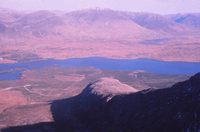 The Horseshoe, a view of Derryclare Lough from the top of Derryclare
Derryclare Mountain (677m) lies at the south-eastern end of the Horseshoe ridge. This view of Derryclare Lough is taken looking south-east from near the summit.
This is one of 7 photographs taken during a day in 1971 or 1972 that the UCG Mountaineering Club spent hiking in the southern Twelve Bens. For the other 6 photographs see 'A day on the Horseshoe ridge'.
In 2022 Michael Kane gave a vivid account of this particular outing and the general activities of the Mountaineering Club in its early days. See 'Michael Kane's account of the Mountaineering Club c. 1971-72'.
The Mountaineering Club was established in 1970. Its membership in 2023 was over 1000.(Mountaineering Club, 'About us'). The Library archives contain a number of documents relating to the club. These were placed in the care of the University by Aengus Finnegan, Secretary 2010-2011 (Mountaineering Club, 'Archive').
The Glencoaghan (Gleann Chóchan) Horseshoe ridge is approximately 16 km long. Its peaks include 7 of the major bens: Binn Leitrí (Benlettery, 577m), Binn Ghleann Uisce (Ben Glenisky, 516m), Binn Gabhar (Bengower, 664m), Binn Bhraoin (Benbreen, 691m), An Bhinn Dubh (Bencollaghduff, 696m), Binn Chorr (Bencorr, 711m) and Binn Doire Chláir (Derryclare, 677m). It also comprises some subsidiary bens, among them Binn an Choire Bhig (Benncorrbeg, 577m) and Binn an tSaighdiúra (653m).
-
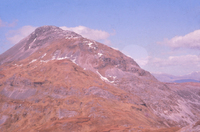 Benbaun, the highest peak of the Twelve Bens in all its glory
A view of Benbaun (Benbawn or An Bhinn Bhán ), at 729m the highest of the Twelve Bens, seen from the Horseshoe ridge.
This is one of 7 photographs taken during a day in 1971 or 1972 that the UCG Mountaineering Club spent hiking in the southern Twelve Bens. For the other 6 photographs see 'A day on the Horseshoe ridge'.
In 2022 Michael Kane gave a vivid account of this day on the Horseshoe and the general activities of the Mountaineering Club. See 'Michael Kane's account of the Mountaineering Club c. 1971-72'.
The Mountaineering Club was established in 1970. Its membership in 2023 was over 1000. (Mountaineering Club, 'About us'). The Library archives contain a number of documents relating to the club. These were placed in the care of the University by Aengus Finnegan, Secretary 2010-2011 (Mountaineering Club, 'Archive').
-
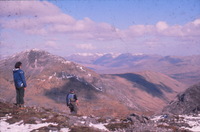 The Horseshoe in snow with Benbaun on the left
Two members of the UCG Mountaineering Club on the Horseshoe ridge with Benbaun, the highest of the Twelve Bens, in the background.
This is one of 7 photographs taken during a day in 1971 or 1972 that the UCG Mountaineering Club spent hiking in the southern Twelve Bens. For the other 6 photographs see 'A day on the Horseshoe ridge'.
In 2022 Michael Kane gave a vivid account of this day on the Horseshoe and the general activities of the Mountaineering Club. See 'Michael Kane's account of the Mountaineering Club c. 1971-72'.
The Mountaineering Club was established in 1970. Its membership in 2023 was over 1000.(Mountaineering Club, 'About us'). The Library archives contain a number of documents relating to the club. These were placed in the care of the University by Aengus Finnegan, Secretary 2010-2011 (Mountaineering Club, 'Archive').
The Glencoaghan (Gleann Chóchan) Horseshoe ridge is approximately 16 km long. Its peaks include 7 of the major bens: Binn Leitrí (Benlettery, 577m), Binn Ghleann Uisce (Ben Glenisky, 516m), Binn Gabhar (Bengower, 664m), Binn Bhraoin (Benbreen, 691m), An Bhinn Dubh (Bencollaghduff, 696m), Binn Chorr (Bencorr, 711m) and Binn Doire Chláir (Derryclare, 677m). It also comprises some subsidiary bens, among them Binn an Choire Bhig (Benncorrbeg, 577m) and Binn an tSaighdiúra (653m).
Benbaun, Benbawn or An Bhinn Bhán (729m) is not part of the Horseshoe.
-
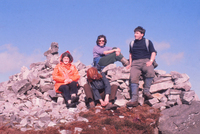 The Horseshoe, a well-earned rest for the group, 1971 or 1972
Members of the UCG Mountaineering Club taking a rest on the Horseshoe ridge during a day spent hiking in the southern Twelve Bens.
This is one of 7 photographs taken during an outing in 1971 or 1972. For the other 6 photographs see 'A day on the Horseshoe ridge'.
In 2022 Michael Kane gave a vivid account of this day on the Horseshoe and the general activities of the Mountaineering Club. See 'Michael Kane's account of the Mountaineering Club c. 1971-72'.
The Mountaineering Club was established in 1970. Its membership in 2023 was over 1000.(Mountaineering Club, 'About us'). The Library archives contain a number of documents relating to the club. These were placed in the care of the University by Aengus Finnegan, Secretary 2010-2011 (Mountaineering Club, 'Archive').
The Glencoaghan (Gleann Chóchan) Horseshoe ridge is approximately 16 km long. Its peaks include 7 of the major bens: Binn Leitrí (Benlettery, 577m), Binn Ghleann Uisce (Ben Glenisky, 516m), Binn Gabhar (Bengower, 664m), Binn Bhraoin (Benbreen, 691m), An Bhinn Dubh (Bencollaghduff, 696m), Binn Chorr (Bencorr, 711m) and Binn Doire Chláir (Derryclare, 677m). It also comprises some subsidiary bens, among them Binn an Choire Bhig (Benncorrbeg, 577m) and Binn an tSaighdiúra (653m).
-
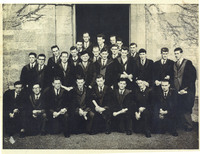 Engineering Graduate Class, 1956
In this photograph of the Engineering Graduation Class of 1956 Professor W.H. Prendergast (third row, fourth from left) is seen surrounded by graduands.
William Hillary Prendergast took up the Professorship of Civil Engineering in 1947, vacated on health grounds by Professor Frank Sharman Rishworth. Professor Prendergast obtained degrees in Engineering and Science from UCG in 1915. He was involved with the Eastern Bengal-Assam Railway from 1920, as well as the railway line between Basra and Baghdad during WWII, details of which are further described by Paul Duffy. He died suddenly on 22 July 1957.
Key to people, left to right:
Back row: Paddy Hoare, Con McCawley, Joe Kinneen, George Lee, and one unidentified.
Third row: Frank Furey, Joe Dalton, Tom O’Sullivan, Des Sweeney, Gerry Mahony.
Second row: John Considine, Joe Curley, Brian Murphy, Prof, William ('Willie') Prendergast, Seán McDermott, Michael Lee, Tom Codyre, Pat Flood, Ernie Hession.
Front row: Michael Higgins, Pat Keating, Dickie Roche, Tom Leyden, Enda Conway, Seamus Martin, Johnny Donnellan, Séamus Horan.
-
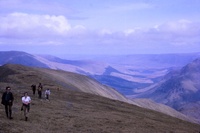 Mountaineering Club near the top of Mweelrea, c. 1976-1978
A small group of the Mountaineering Club's members climbing towards the summit of Mweelrea (Cnoc Maol Réidh), one of the Twelve Bens in Connemara. At 814m its summit is the highest point in Connacht.
In 2022 Michael Kane gave a vivid account of the activities of the Mountaineering Club in its early days. See 'Michael Kane's account of the Mountaineering Club c. 1971-72'.
The Mountaineering Club was established in 1970. Its membership in 2023 was over 1000.(Mountaineering Club, 'About us'). The Library archives contain a number of documents relating to the club. These were placed in the care of the University by Aengus Finnegan, Secretary 2010-2011 (Mountaineering Club, 'Archive').
-
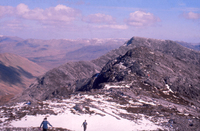 Half-way point, the ridge between Benbreen and Bencollaghduff, 1971 or 1972
One of 7 photographs taken during a day the UCG Mountaineering Club spent in the southern Twelve Bens in 1971 or 1972. For the other 6 photographs see 'A day on the Horseshoe ridge'.
In 2022 Michael Kane gave a vivid account of this day on the Horseshoe and the general activities of the Mountaineering Club. See 'Michael Kane's account of the Mountaineering Club c. 1971-72'.
The Mountaineering Club was established in 1970. Its membership in 2023 was over 1000.(Mountaineering Club, 'About us'). The Library archives contain a number of documents relating to the club. These were placed in the care of the University by Aengus Finnegan, Secretary 2010-2011 (Mountaineering Club, 'Archive').
The Glencoaghan (Gleann Chóchan) Horseshoe ridge is approximately 16 km long. Its peaks include 7 of the major bens: Binn Leitrí (Benlettery, 577m), Binn Ghleann Uisce (Ben Glenisky, 516m), Binn Gabhar (Bengower, 664m), Binn Bhraoin (Benbreen, 691m), An Bhinn Dubh (Bencollaghduff, 696m), Binn Chorr (Bencorr, 711m) and Binn Doire Chláir (Derryclare, 677m). It also comprises some subsidiary bens, among them Binn an Choire Bhig (Benncorrbeg, 577m) and Binn an tSaighdiúra (653m).
-
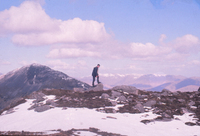 Michael Kane on a ridge with Benbaun in background, 1971 or 1972
Michael Kane is seen here on the Horseshoe ridge with Benbaun, the highest of the Twelve Bens, in the background. This is one of 7 photographs taken during a day in 1971 or 1972 that the UCG Mountaineering Club spent hiking in the area. For the other 6 photographs see 'A day on the Horseshoe ridge'.
In 2022 Michael Kane gave a vivid account of this particular outing and of the general activities of the Mountaineering Club in its early days. See 'Michael Kane's account of the Mountaineering Club c. 1971-72'.
The Mountaineering Club was established in 1970. Its membership in 2023 was over 1000.(Mountaineering Club, 'About us'). The Library archives contain a number of documents relating to the club. These were placed in the care of the University by Aengus Finnegan, Secretary 2010-2011 (Mountaineering Club, 'Archive').
The Glencoaghan (Gleann Chóchan) Horseshoe ridge is approximately 16 km long. Its peaks include 7 of the major bens: Binn Leitrí (Benlettery, 577m), Binn Ghleann Uisce (Ben Glenisky, 516m), Binn Gabhar (Bengower, 664m), Binn Bhraoin (Benbreen, 691m), An Bhinn Dubh (Bencollaghduff, 696m), Binn Chorr (Bencorr, 711m) and Binn Doire Chláir (Derryclare, 677m). It also comprises some subsidiary bens, among them Binn an Choire Bhig (Benncorrbeg, 577m) and Binn an tSaighdiúra (653m).
-
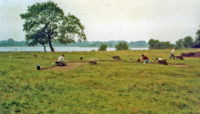 Archaeological excavation at Ballaghkeeran, 1982
The trial excavation pictured here was conducted by Professor Thomas ('Tom') Fanning of the Archaeology Department, UCG, in 1982. His report gives the following details:
'Co. Westmeath 1982. 184. Ballaghkeeran Little, Athlone (12N 073445). T. Fanning of Department of Archaeology, University College, Galway, excavated a number of trial trenches at a fortified promontory on Lough Ree in the R. Shannon. The possibility that the site was a Viking-type longphort was borne in mind due to the mid 9th- and early l0th-century references to a Viking fortification on the Lough.
Excavation of the earthen bank on the landward side of the promontory showed it to have been of a substantial nature composed of a fine sandy subsoil redeposited on the original ground surface. A charcoal stain close to the inner edge of this bank was sampled for a radiocarbon determination. The cuttings within the promontory exposed two shallow parallel trenches c.10m apart. These features, detected in a magnetometer survey by R. Doggart of Queen's University, Belfast, yielded a little charcoal but no finds or other evidence of occupation - the earth had been considerably disturbed by rabbit burrowings and ridge-and-furrow cultivation. Some iron slag and fragments of fired clay were found in a cutting made directly S. of the promontory in a large banked-up hollow beside the mouth of the Breensford River' (T. Fanning, 1983).
Tom Fanning conducted numerous other excavations. For one of these, undertaken at Rinnaraw, Co. Donegal, in 1987-92, there is, in addition to a later scientific report (Comber et al., 2006), a vivid account from the student fieldworker's perspective, provided by Robert Chapple, archaeologist, in his blog (Chapple, 2014).
-
 French play in An Taibhdhearc, 1971
Two lectrices in the UCG French Department, Claude Mouton and Marie-Paule Péry, and their students put on a French play, Le Bal des voleurs, in An Taibhdhearc on April 25, 1971. Claude was the producer and Marie-Paule directed the play. In 2022, Michael Kane, Claude's husband, wrote an account of the production and some of the students involved. In it he included an extract from a radio interview in which Colm Murray, the well-known broadcaster, reminisced about his role as Gaston, the young male lead. See 'Michael Kane's account of a French play in An Taibhdhearc'.
-
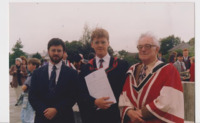 Labhrás Ó Núalláin at Conor Ó Dochartaigh's graduation, 1993
Labhrás Ó Nualláin, who was a lecturer in and subsequently Professor of Economics, is seen here with his two grandsons, Niall and Conor Ó Dochartaigh, at the latter’s graduation. Labhrás was married to Frances Heraghty from Donegal. Their daughter Niamh married Dr Eoin Ó Dochartaigh, and the two young men seen here are their sons.
Niall Ó Dochartaigh is Personal Professor of Political Science and Sociology at the University of Galway. His brother Conor is a medical consultant in Auckland, New Zealand.
From left to right: Eoin Ó Dochartaigh, Conor Ó Dochartaigh and Labhrás Ó Nualláin.
-
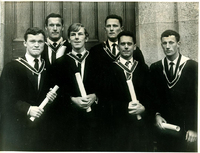 MSc class of 1965
-
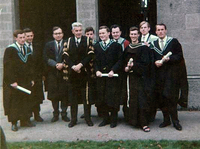 MSc postgraduates with staff, 1965
Pictured here, from left to right:
Unidentified; Seán Tobin; Jim Flavin; President Martin J. Newell (Máirtín Ó Tnúthail); Unidentified; Ted (Thaddeus C. ) Hurley; Matthew F. McCarthy; Unidentified Franciscan brother; Unidentified; Unidentified.
-
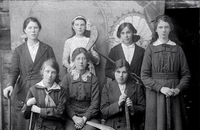 Camogie players, 1921
Two of the camogie players pictured here have been identified: Margaret M. Carlos, known as Rita (seated, centre) and Mary J. Carlos, known as Nina (standing, left). In 1916 UCG competed for the Ashbourne Cup in the intercollegial camogie tournament which had been established the previous year. It was won by UCG in 1917 and 1920 and a further 13 times between then and 2022.
'Some members of the UCG winning 1917 team refused to have their names engraved on the cup in the Irish language, something that brought their future selection into doubt.' (Wikipedia). There are interesting anecdotes regarding the Ashbourne in later decades (including Siobhán McKenna’s prowess) in Jackie Uí Chionna's Oral History of University College Galway.
The camogie sticks at the time were differently shaped to those used today. It was, and is, usual to inscribe one’s name on the stick or camán. Nina's name is clearly visible on her stick, and ‘A’ can be seen on that of the young woman seated on the left.
-
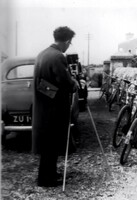 UCG film unit in action, 1960s
People: Patt Larkin
Patt Larkin, Professor of Education, who initiated the UCG Aonad Scannáin (Film Society) in 1947, was an enthusiastic photographer and amateur film-maker.
The car's number plate indicates that it was registered in Dublin County and County Borough between May 1953 and May 1954.
-
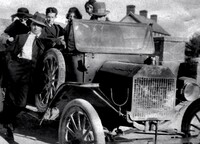 Motorists at Beggars Bridge, 5 June 1921
The elegantly dressed young man leaning against the car and his companion in the front seat are doing a creditable imitation of Prohibition-era gangsters. None of those present have been identified. The motorcar was still a relatively rare and prized possession in the early 1920s and this photo conveys how students associated it with special outings and social life.
Beggars Bridge is the bridge that crosses the Gaol River, just to the north-west of the Cathedral, on University Road.
-
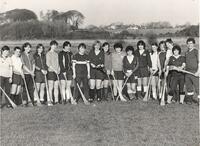 Camogie team, 1982
In 1982 the UCG camogie team competed as usual for the Ashbourne Cup which was won that year by UCD. When this photo was taken, UCG's most recent success had been in 1979, and they were to regain the Cup in 1989, retaining it in 1990. Between 1916, when UCG first entered the competition, and 2023, the Cup has come to the University of Galway 15 times.
The photo appears to have been taken at a training session or perhaps a local match, as it shows considerable variation in the kit worn by the players. It reflects a relatively recent relaxation of the rules: the appropriate wear for women had been a focus of concern in the GAA early in the history of the game. In 1903, the first set of rules dictated that skirts must be no more than 6 inches from the ground. In the 1970s a blouse worn with a skirt, shorts or a divided skirt became officially acceptable.
-
 A new student at UCG, 1953
Pictured here is Frank Imbusch as a new student in UCG. The photograph conveys how relatively uncrowded the main campus was in the 1950s. Before the era of Open Days and orientation tours, arriving at University for the first time was a very different experience to the present one.
It was not until 1960 that student numbers passed 1,000 (Cois Coiribe, 2021). By 2023 there were over 18,000. There had been just 68 when the University opened its doors in 1849.
-
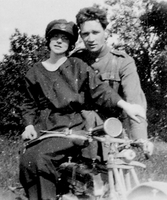 Ed Thornton with Brigid Lyons at UCG
Pictured here, from left to right: Brigid or Brighid Lyons, and Edward ('Ed') Thornton. When they married in 1925, Brigid added Thornton to her maiden name, and was thereafter known as Brigid Lyons Thornton.
Born in 1896, Brigid Lyons was from Northyard, near Scramogue, Co. Longford. From 1915 to 1922 she studied medicine in Galway, where she helped to found a branch of Cumann na mBan. In 1916 she participated in the Easter Rising. After a brief period in the Army Medical Service she pursued a long and distinguished career in public health.
'Throughout her life Brigid Thornton fought for the underprivileged, believing strongly that women had an important contribution to make in many occupations traditionally dominated by men. Injustice and deprivation moved her, and she used her energy to fight for the rights of political prisoners, for Belgian refugees, and for the right of women to vote.' (DIB)
Captain Edward ('Ed') Thornton (b. 1899) was from Co. Mayo. The couple met in Nice where both were convalescing from tuberculosis. They returned to Ireland and married in 1925. Edward Thornton passed the Bar and worked as solicitor, wintering in Switzerland. He died suddenly in 1947 and was buried in Toomore Cemetery, near Foxford. When Brigid died in April 1987 she was buried with military honours beside her husband.
